SOC 2 sales cycle Most articles about “SOC 2 and sales velocity” traffic in hypotheticals. This one doesn’t have to. There’s a well-documented, publicly verifiable case that shows exactly how this plays out in practice — and it’s worth walking through in detail, because the pattern shows up again and again across companies of very different sizes and industries.
Note on sourcing
The primary case study below is Formsort, documented directly by Secureframe (the compliance automation platform Formsort used), with named quotes from Formsort’s COO. It’s cited and linked throughout — this is not a B4Q client engagement, and it’s presented here because it’s one of the clearest, most concrete public examples of the exact problem B4Q helps solve. We’ve supplemented it with two other named, sourced examples for a fuller picture.
The Company: Formsort
Formsort builds a low-code form platform — the infrastructure behind things like mortgage applications, e-commerce checkouts, and healthcare intake flows. Customers include GoodRx, Vial, Calibrate, and Balance Homes. Forms, as a category, sit exactly where sensitive data changes hands, which is precisely why security became non-negotiable for their buyers.
The Problem: Winning the Deal Isn't the Same as Closing It
As Formsort moved upmarket, a pattern emerged that will sound familiar to almost any B2B SaaS founder who’s sold into regulated industries: prospects — many in healthcare and finance — loved the product, but their security teams wouldn’t sign off without a SOC 2 Type II report. Formsort didn’t have one.
In the meantime, every deal in the pipeline required its own custom security questionnaire. Formsort’s COO Cansu Aydede put it plainly: their clients were demanding compliance, and without it, they were stuck filling out bespoke vendor questionnaires for every single deal. That’s not a one-time cost — it’s a recurring tax on every enterprise conversation, and critically, it was consuming hours of the CTO’s time on work that had nothing to do with building the product.
This is not a Formsort-specific problem. PerkUp, an employee gifting platform, hit the identical wall as it moved beyond small startup customers into accounts with dedicated Finance and IT security stakeholders. Their CEO described the pre-SOC 2 questionnaire process as consistently costing him and his CTO two to three hours per deal, on top of two to three weeks of calendar time per review — and these were, in his words, deals that mattered materially to the business. Abmatic AI, an account-based marketing platform, ran into the same block from the opposite direction: two major customers explicitly would not move forward without a SOC 2 report in hand, full stop.
Three different companies, three different products, the same exact chokepoint.
What the Data Says This Actually Costs
This isn’t just anecdotal. Current benchmark research on enterprise SaaS sales cycles backs up exactly what these founders experienced:
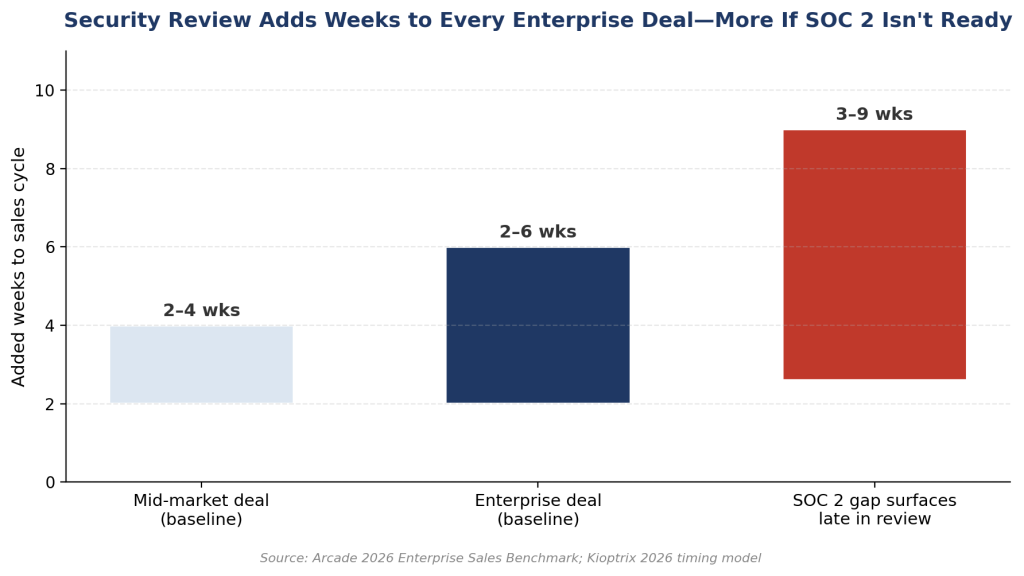
- Security review alone now adds 2–6 weeks to most enterprise sales cycles, and 2–4 weeks even for mid-market deals, according to Arcade’s 2026 sales benchmark research. – When SOC 2 or vendor-risk gaps surface late in a deal — which is exactly what happens when a company doesn’t have a report ready — that delay extends by another 10–21 days, per a 2026 timing model cited in enterprise sales research.
- SOC 2, GDPR, and vendor risk documentation that used to be an enterprise-only requirement is now standard even at companies with as few as 200 employees — meaning the problem Formsort and PerkUp hit isn’t confined to Fortune 500 procurement anymore. It’s showing up earlier in the buyer size curve every year.
And the stakes for getting security wrong go beyond a slower sales cycle. IBM’s 2025 Cost of a Data Breach Report puts the average cost of a US data breach at $10.22 million — a record high, up 9% year-over-year — with healthcare specifically averaging $7.42 million per incident. The same rigor that unblocks a deal is the rigor that keeps a company off that list.
What Formsort Actually Did
Formsort partnered with Secureframe to pursue SOC 2 Type II compliance — the more rigorous of the two SOC 2 report types, since it verifies controls operated effectively over an observation period rather than just being designed correctly at a single point in time. According to the published case study, the value wasn’t just the software — it was the combination of automated evidence collection, a direct connection to an auditor, and hands-on guidance through the parts of the process that don’t fit neatly into a checklist. Aydede specifically credited the process with being structured and streamlined enough that the team could focus on their actual business, while still having a real person to talk to when something didn’t fit the standard playbook.
That last point matters more than it might seem. Nearly every founder account of a SOC 2 project — Formsort’s included — mentions the same thing: software alone doesn’t get you through an audit. Automated evidence collection removes a lot of manual grind, but someone still has to scope the engagement correctly, make judgment calls on ambiguous controls, and actually sit across from an auditor who’s asking hard questions. The tooling and the human expertise are doing two different jobs.
The Result
The published outcome, in Secureframe’s own numbers: Formsort completed SOC 2 Type II compliance in a fraction of the time a traditional process would have taken, accelerated its average sales cycle by more than two weeks by eliminating the need for bespoke vendor questionnaires, and freed up senior leadership time that had previously gone into answering the same security questions over and over.
PerkUp’s result was even more dramatic on the questionnaire-elimination side specifically: security review time dropped from two to three weeks down to one or two days. In one case, they sent their new SOC 2 report to a prospect and had it approved the same day. Abmatic AI’s timeline was the fastest of the three — SOC 2 compliant in six business days — and both of the deals that had been contingent on that report converted to revenue immediately afterward.
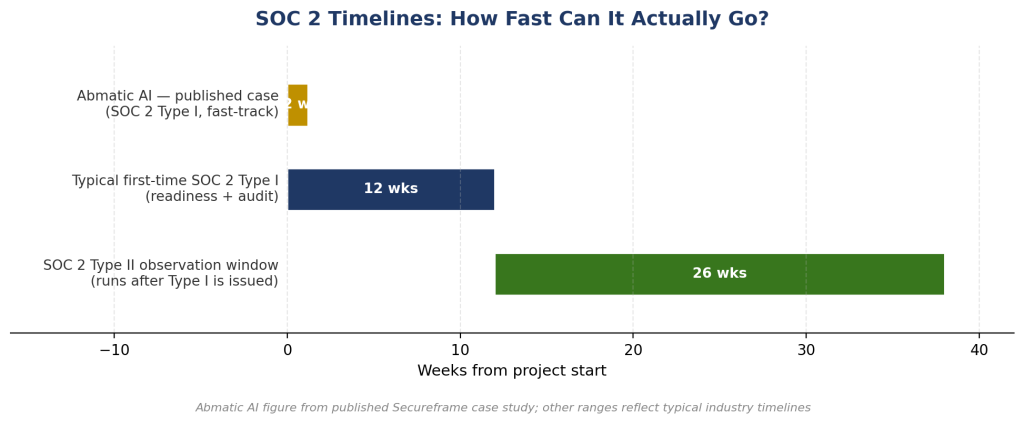
Worth flagging honestly: Abmatic AI’s six-day timeline is the exception, not the baseline — most first-time SOC 2 Type I engagements run closer to 8-12 weeks once readiness work and gap remediation are factored in. Their speed likely reflects an already-mature control environment going in.
The Pattern Underneath All Three Stories
Strip away the product differences and the same structure repeats:
- The trigger is almost always a specific deal, not a proactive security initiative. Nobody in these stories woke up one day and decided SOC 2 sounded like a good use of engineering time — a real prospect, with real revenue attached, made it non-negotiable.
- The cost of not having it isn’t just “slower.” It’s founder and CTO hours, repeatedly, on work that doesn’t build the product or grow the pipeline. PerkUp’s CEO quantified it directly: two to three hours per deal, every deal, indefinitely.
- The report itself becomes reusable leverage. Once it exists, it replaces the custom questionnaire process entirely — a single, third-party-verified document instead of a bespoke negotiation with every new prospect’s security team.
- Speed matters, but so does getting it right. Every one of these companies needed the report fast because a real deal was waiting — but a report that doesn’t hold up to real audit scrutiny is worse than no report at all, because it burns the trust of the next enterprise buyer who checks.
What This Means If You're the One Staring at This Right Now
If you recognize this pattern — a deal stalled in security review, a CTO or founder burning hours on questionnaires that all ask some version of the same 150 questions, a prospect’s legal team asking for a report you don’t have — the path forward looks a lot like what Formsort, PerkUp, and Abmatic AI each went through, with one structural decision to make early: who actually issues your report.
This is where it’s worth being precise about something the compliance software category doesn’t always make obvious. Platforms like Secureframe automate evidence collection and manage the process — genuinely useful — but none of them are licensed CPA firms, and none of them can issue the SOC 2 report itself. That still requires an actual audit conducted by a licensed CPA firm. In every one of the case studies above, the software vendor connected the customer to a separate accredited auditor to complete the engagement.
B4Q approaches this from the other direction: as the licensed CPA firm that can run the readiness assessment *and* issue the report itself, without a second vendor relationship in the middle. For a company that’s watching a real deal stall right now, that usually means:
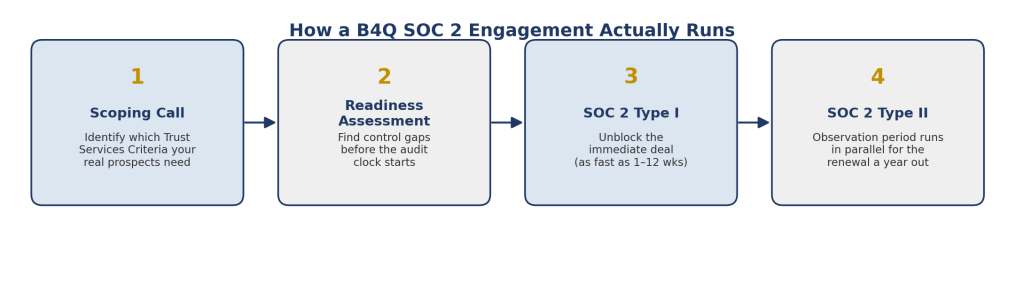
– A scoping conversation focused on exactly which Trust Services Criteria your actual prospects are asking for — not the broadest possible audit, which costs more and takes longer than most early-stage companies need.
– A readiness assessment that identifies real gaps before the audit clock starts, so there are no surprises mid-engagement.
– A Type I to unblock the immediate deal, with a Type II observation period running in parallel for the renewal that’s coming twelve months later — the same sequencing every company in this article ultimately needed.
The Honest Caveat
Every case study, including the ones cited here, is a survivorship story — these are the companies that got through it and were willing to talk about it publicly. What the public case studies tend to underplay is the internal lift required even with a good partner: policies still need real owners, engineers still need to implement the actual controls (not just document them), and leadership buy-in — mentioned specifically in more than one account of failed or delayed SOC 2 projects elsewhere — is usually the difference between a report delivered on schedule and one that slips a quarter.
If your business is at the point where a real prospect is asking the question, the fastest mistake to make is treating it as a fire drill you solve once and forget. The three companies above didn’t just get a report — they got a repeatable process that made every subsequent deal faster than the last one. That’s the actual return on the investment, not just the report itself.