AI SOC 2 Type II vs Type I report proves your security controls exist and are designed correctly on one specific day. A SOC 2 Type II report proves those same controls actually worked, consistently, over months. It’s the difference between showing someone a fire extinguisher on the wall and showing them footage of it actually putting out a fire. Most companies start with Type I because it’s faster — but the real business value, according to nearly every company that’s talked publicly about it, shows up once Type II is in hand.
The case below is Wealth, a digital estate planning platform, documented directly by Secureframe with named, on-the-record quotes from Wealth’s own VP of Security and Content Director. It’s cited and linked throughout. This is not a B4Q client engagement — it’s included because it’s one of the clearest public examples of what a Type II report actually changes for a business, and the honest structural difference between a software platform managing that process and a CPA firm issuing the report itself is explained at the end.
The Company: Wealth
Wealth builds a digital estate planning platform — pulling together a person’s full financial picture in one place, with machine-learning-backed recommendations to keep plans current as life circumstances change. That means the platform handles some of the most sensitive data a person owns: full asset inventories, beneficiary details, and — because Wealth regularly partners directly with financial institutions — data that touches other companies’ compliance obligations too.
The Problem: "How Do You Protect Our Data?"
According to Wealth’s VP of Security, Jair Basso, that question — how do you protect our data, how do you protect our customer’s data — was consistently the first thing prospective financial-institution partners asked. In an industry where the entire product is trust with someone’s life savings and legacy, a vague answer wasn’t going to close deals with “bigger companies with complex security requirements,” in Basso’s words. Wealth needed a way to prove, not just assert, that it followed industry-leading security practices.
Basso already knew from past experience that getting there the manual way — building the evidence trail by hand — would eat enormous amounts of his team’s time. That expectation turned out to be accurate: before automating the process, Wealth’s compliance team had to individually pull evidence from every third-party system by hand, one at a time.
Why Type II Specifically, Not Just Type I
This is the part of the story that matters most for anyone deciding which report to pursue. Wealth didn’t stop at Type I. They went for — and completed — SOC 2 Type II, the version that requires proving controls operated effectively over an actual observation window, not just that they were designed correctly on paper.
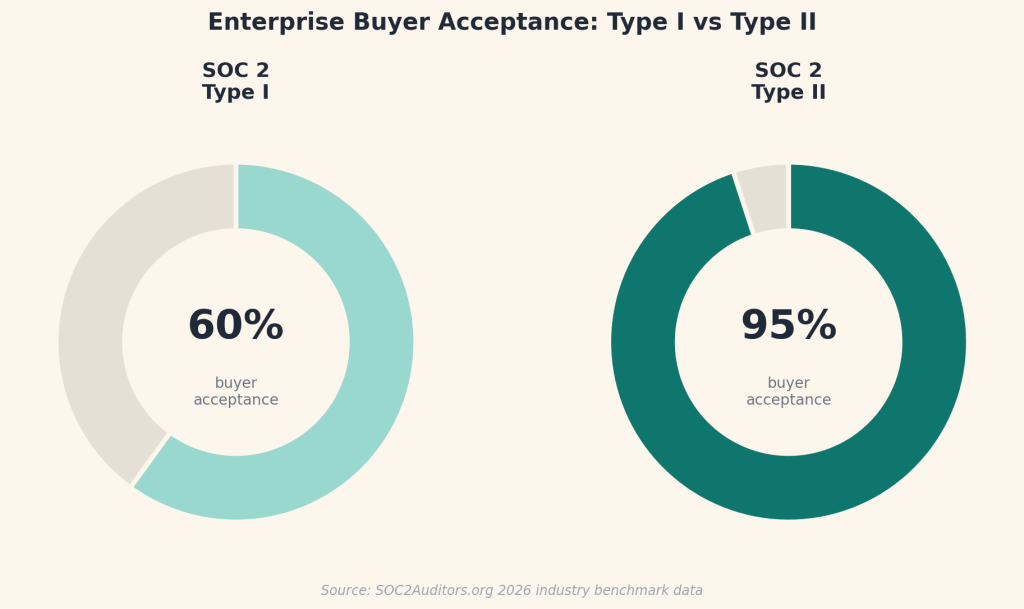
The data backs up why that distinction is worth the extra time and cost. Industry benchmarking on SOC 2 adoption puts it in stark terms: a Type I report is accepted by roughly 60% of enterprise buyers, while a Type II report expands that acceptance to roughly 95%. For a company like Wealth — selling directly to financial institutions with the least tolerance for ambiguity in the market — that gap isn’t a rounding error, it’s the difference between being in the room and being screened out before the conversation starts.
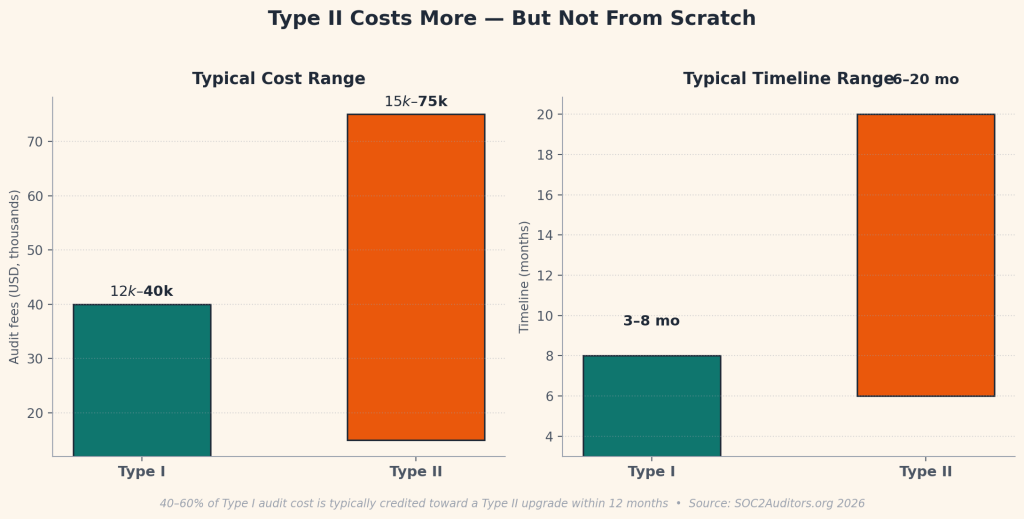
The cost and timeline gap between the two report types is real, but smaller than most founders expect once you account for what’s shared:
– **SOC 2 Type I**: typically $12,000–$40,000 in audit fees, 3–8 months from a standing start.
– **SOC 2 Type II**: typically $15,000–$75,000, 6–20 months — but critically, the underlying control design work is identical to Type I. The added cost and time is almost entirely the observation window itself, not duplicated effort. Most auditors will credit 40–60% of a completed Type I engagement toward a Type II upgrade within the following 12 months.
That’s the financial logic behind why so many companies — Wealth included — treat Type I less as a destination and more as a waypoint on the way to Type II.
What Wealth Actually Did
Wealth partnered with Secureframe to automate the evidence-gathering work that had previously consumed so much manual effort — connecting directly into their cloud environment, authentication systems, and HR platforms rather than pulling evidence system-by-system by hand. The engagement ran roughly six months from start to a completed Type II report.
Formsort — the company at the center of our first case study in this series — went through the same Type I-to-Type II decision and quantified the payoff directly. According to COO Cansu Aydede, achieving Type II specifically shortened their sales cycle by at least a couple of weeks and increased how often those sales conversations actually converted, not just how fast they moved. That second point is easy to miss: Type II doesn’t just speed up deals that were going to close anyway, it appears to change the outcome of deals that were genuinely in question.
Coda, a productivity software company, tells a similar version of the story from a different angle. Coda pursued both SOC 2 Type I and Type II reports without hiring an external consultant, specifically because leadership wanted a compliance partner rather than “another tool” bolted onto the business. With both reports in hand, Coda closed several large opportunities that — in their own account — would not have been possible without them. They’ve since moved on to pursuing HIPAA compliance next, treating the SOC 2 foundation as the base a broader compliance program builds on rather than a one-time project.
The Result
The published outcome for Wealth is specific and rare in this space: they became the only digital estate planning platform holding SOC 2 Type II compliance. According to Wealth’s Content Director, Lucas Miller, that distinction is a genuinely difficult bar to clear — and one that’s become central to how the company talks to the market, not just to auditors. Being able to describe the actual audit process and the security validation behind it, in Miller’s words, is now core to both sales and marketing, not a compliance footnote buried in a footer link.
The Pattern Underneath This Story
A few things repeat across Wealth, Formsort, and Coda that are worth naming directly:
- Type I answers “do you have controls.” Type II answers “do they actually work.” Sophisticated buyers — the kind evaluating a platform that holds someone’s entire estate plan — are asking the second question, not the first.
- The acceptance-rate gap is the real ROI calculation. Going from roughly 60% to roughly 95% enterprise buyer acceptance isn’t a nice-to-have upgrade; for companies selling into finance, healthcare, or other high-scrutiny buyers, it’s closer to a market-access requirement.
- The marginal cost of Type II is smaller than it looks, because the control design work doesn’t get repeated — the observation period is the added cost, and most auditors credit prior Type I work toward it.
- The report becomes a market-facing asset, not just a procurement checkbox. Wealth’s team talks about their SOC 2 Type II status in marketing conversations, not just security questionnaires — a use case that only works because Type II carries enough weight to be worth bragging about.
What This Means If You're Deciding Between Type I and Type II Right Now
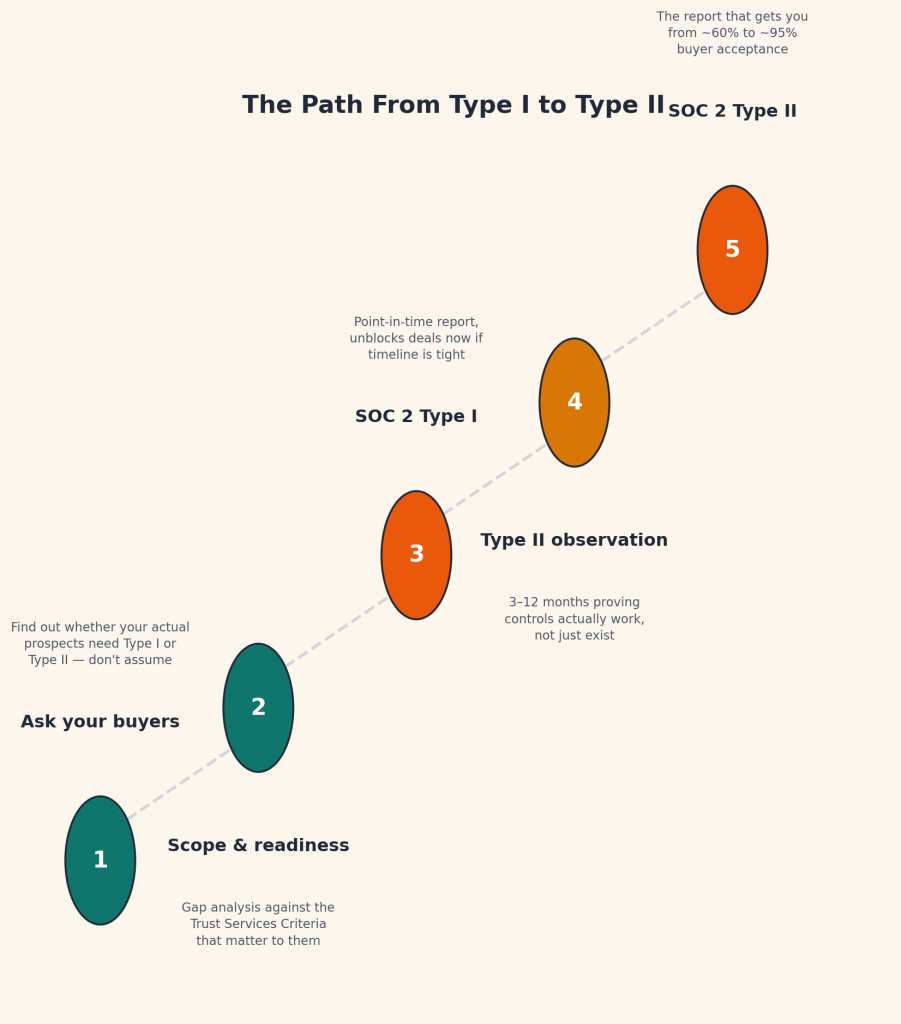
If a specific deal is on the clock and a Type II observation period genuinely won’t fit the timeline, Type I remains the right emergency move — it’s faster, it’s real, and it buys the runway to start the Type II clock immediately afterward. But if you have even a few months of room, the data above makes a fairly direct case: most companies end up needing Type II eventually, and starting the observation period sooner rather than doing Type I first and stalling is usually the more efficient path, not the slower one.
This is also where the structural distinction between a compliance software platform and a CPA firm matters again. Automating evidence collection — which is what made Wealth’s and Formsort’s engagements faster — is genuinely useful, but the report itself, Type I or Type II, still has to be issued by a licensed CPA firm after real audit fieldwork. B4Q’s approach for a company facing this exact decision typically starts with an honest conversation about which report your actual buyer base needs — not the report that’s fastest to sell, but the one that will actually stop getting rejected at procurement — followed by a scoped readiness assessment and a Type I/Type II sequencing plan built around your real sales calendar, not a generic template.
The Honest Caveat
Wealth’s “only platform in our category with Type II” positioning is a genuinely strong result, but it’s also somewhat category-specific luck — being first to a high bar in a narrow niche is a different achievement than doing it in a crowded category where every competitor already has one. The 60%-to-95% acceptance figures are industry benchmarks, not a guarantee for any specific company’s buyer base; the only way to know what your specific prospects actually require is to ask them directly, which is the first step of any serious SOC 2 planning process, not an afterthought.