SOC 2 report enterprise buyers : What Enterprise Buyers Expect to See
Getting a SOC 2 report enterprise buyers is only half the job. The other half is knowing what an enterprise buyer’s security and procurement team actually does with it once it lands in their inbox — because a report that doesn’t match what they’re checking for can stall a deal just as easily as having no report at all.
What Enterprise Buyers Actually Mean When They Ask for "SOC 2"
“Send us your SOC 2 report enterprise buyers” is often shorthand for several different requests bundled into one. One buyer wants the SOC 2 Type II report, another wants a bridge letter, and another is really looking for trust center access or a completed security questionnaire. Figuring out which one you’re actually being asked for, early, avoids sending the wrong document into a review cycle.
| What buyer says | What they usually mean | What satisfies it |
|---|---|---|
| "Your SOC 2 report" | The signed CPA attestation, usually under NDA | Type II PDF, current within ~12 months |
| "Proof you're SOC 2 compliant" | Evidence controls are still operating, not just a logo | Current report + bridge letter if the period has lapsed |
| "Complete our security questionnaire" | A self-reported control mapping, not an audit | Questionnaire answers cross-referenced to your report |
| "Trust center access" | Ongoing visibility, not a one-time document drop | A maintained trust portal or shared drive |
What Changed for Enterprise Buyer Expectations in 2026
The five Trust Services Criteria haven’t moved since 2017, but how closely buyers scrutinize a report has. A few shifts worth knowing:
- Type II is now the default ask — most enterprise buyers want to see controls operating over a period, not a single snapshot.
- Reports are getting thicker, and buyers notice thin ones — a report too limited in scope can halt a deal due to lack of clarity.
- Continuous monitoring is replacing annual check-ins, since static questionnaires leave procurement teams blind between review cycles.
- Framework mapping matters more, as buyers operating under HIPAA, ISO 27001, GDPR, or DORA expect vendors to align SOC 2 report enterprise buyers controls with those regimes.
- Third-party risk is a named line item — third parties were involved in 30% of confirmed breaches in 2025, up from 15% the year before — so vendor and subprocessor disclosures now get read closely.
Quick Definition
Enterprise buyer review: the vendor security and procurement process that uses your SOC 2 report enterprise buyers — alongside bridge letters, security questionnaires, and trust center access — to decide whether your company is an acceptable data-handling risk before a contract is signed or renewed.
Anatomy of the Report Buyers Are Actually Reading
Understanding the structure of your own SOC 2 report enterprise buyers makes it much easier to anticipate what a reviewer will zero in on first.
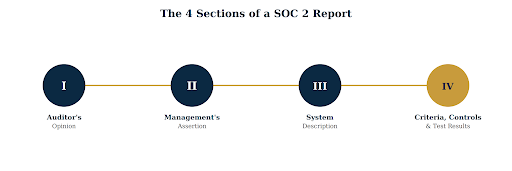
Section I — the independent auditor’s opinion, the fastest thing most reviewers read firs
Section II — management’s assertion about the systems and controls being reported on
Section III — the system description: your infrastructure, data flows, and the boundaries of what’s in scope
Section IV — the Trust Services Criteria, the controls mapped to them, and (for Type II) the actual test results
What's Actually Inside the Report Reviewers Check
| Report section | What the reviewer is checking |
|---|---|
| Management's assertion | Whether your stated scope matches the services actually being purchased |
| Auditor's opinion | Unqualified ("clean"), qualified, or adverse — a qualified opinion invites follow-up questions |
| System description | Whether the systems and boundaries described cover what the buyer is relying on |
| Trust Services Criteria tested | Whether Availability, Confidentiality, or Privacy are included if the deal requires them |
| Tests of controls & results (Type II) | Any noted exceptions or deviations during the observation period |
| Complementary User Entity Controls | Obligations the report assumes the customer will handle on their own side |
| Subservice organization disclosure | Whether cloud hosts or other vendors are carved out or included in testing |
A security reviewer rarely reads a SOC 2 report enterprise buyers cover to cover — they go straight to a handful of sections. Knowing what they’re looking for tells you what to get right before you ever send the PDF.
Why Buyers Are Asking More Often, Not Less
77% of businesses now report that stakeholders demand verified proof of compliance before moving forward.
65% of organizations say customers, investors, and suppliers now require more demonstration of compliance than in previous years.
46% of software buyers prioritize security certifications and data privacy practices when choosing a vendor.
By 2026, 78% of enterprise clients required a SOC 2 Type II report from their vendors, rather than accepting a Type I alone.
71% of SOC 2 reports now include Availability alongside Security, reflecting how often uptime commitments are part of what buyers check.
How an Enterprise Security Review Actually Runs
Intake: the report (or questionnaire) lands with the buyer’s security/procurement team as part of vendor onboarding or renewal.
Cross-check against the questionnaire: buyers map your answers to the Trust Services Criteria to assess whether you’d likely meet SOC 2 requirements.
Report and opinion review: the reviewer checks report currency, scope match, and whether the auditor’s opinion is unqualified.
Exception and gap follow-up: any noted exceptions or excluded subservice organizations trigger direct questions back to you.
Bridge letter request: if your report period has lapsed before renewal, expect a request for interim assurance covering the gap.
Risk acceptance or escalation: the review either clears, or gets escalated with conditions such as contractual security addenda or remediation timelines.
The Cost of Getting This Wrong
- A deal in the security review stage can stall entirely if you don’t have a current report, forcing you to negotiate from a weak position — requesting exceptions, offering harder contractual terms, or delaying the review.
- Existing enterprise customers increasingly add as a contract requirement at renewal, and six-figure ARR has been lost when a vendor couldn’t produce a report in time.
- Most enterprise customers expect a fresh Type II report annually — treating your first report as a one-time achievement rather than an ongoing program is one of the most common reasons renewals get stuck.
SOC 2 Report vs. Security Questionnaire vs. Trust Center
| SOC 2 Report | Security Questionnaire | Trust Center | |
|---|---|---|---|
| Who produces it | Independent CPA firm | Your own team, self-reported | Your team, continuously updated |
| Verification level | Independently audited | Self-attested, unverified | Mix of self-attested and linked evidence |
| Update frequency | Annual (Type II) | Per deal | Continuous |
| Best used for | Formal procurement gating | Early-stage deal screening | Ongoing customer confidence, faster repeat reviews |
Common Mistakes Vendors Make With Enterprise Buyers
Sending an expired or soon-to-lapse report without offering a bridge letter to cover the gap.
Scoping the report around Security only, when the contract already implies Availability or Confidentiality commitments.
Burying subservice organization carve-outs, which buyers read as a transparency red flag rather than a technicality.
Treating security questionnaires as checkboxes — answering with plain “Yes/No” statements instead of mapping each answer to a control with evidence.
Assuming one report satisfies every buyer, instead of asking upfront which artifact — report, bridge letter, or questionnaire — they actually need.
How B4Q Assurance Helps
As a licensed U.S. CPA firm (AICPA) handling SOC 1, SOC 2, and SOC 3 engagements, B4Q Assurance works with B2B SaaS teams to scope reports around what your actual enterprise buyers check — not a generic template — and helps prepare bridge letters and renewal timelines so a stale report never becomes the reason a deal stalls.
Ready to Make Your SOC 2 Report Do Its Job in Procurement?
A report that’s technically compliant but poorly scoped for your buyer base still slows deals down. B4Q Assurance CPA PC works with organizations across the US on SOC 1, SOC 2, and SOC 3 engagements — from readiness assessment through Type I and Type II reporting, with an eye on what your specific enterprise customers actually ask for.
SOC 2 report enterprise buyers Official Resources & Further Reading
- AICPA – Trust Services Criteria (TSP Section 100): the 2017 criteria with revised points of focus (2022), the primary source auditors test against (free account required).
- AICPA – SOC 2 Description Criteria: governs how a service organization’s system description must be written, required alongside the TSC.
- Verizon 2025 Data Breach Investigations Report: industry data on third-party involvement in breaches. https://www.verizon.com/business/resources/reports/dbir/
- ISO/IEC 27001: useful for vendors mapping SOC 2 controls to ISO 27001 for buyers who require both. https://www.iso.org/standard/27001
FAQs
Do enterprise buyers ever accept a Type I report?
Some will, especially for smaller deals or as an interim step, but most large enterprise reviews now expect a Type II report showing controls operated effectively over time.
What's a bridge letter and when do I need one?
It’s a short letter from your auditor confirming controls have continued operating between the end of your last report period and the current date — needed when a buyer’s review falls in that gap.
Do we need to include Availability if our contract doesn't mention uptime?
Not necessarily, but if your buyer’s procurement team is asking about SLAs separately, it’s worth scoping it in rather than fielding the question outside your report.
Can a security questionnaire replace a SOC 2 report entirely?
Usually not for larger deals — most enterprise procurement teams accept a current report in place of large sections of their questionnaire, but rarely drop the report requirement altogether.