
GDPR vs CCPA: Key Differences for Global SaaS Companies
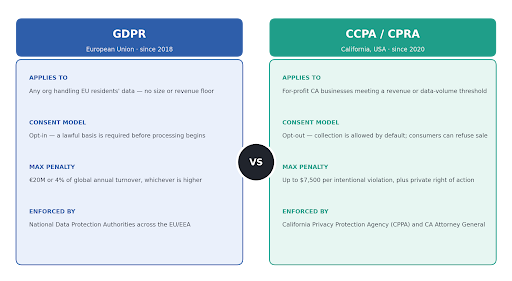
Quick Answer – GDPR vs CCPA both give people control over their personal data, but they start from opposite assumptions. GDPR is an opt-in law: any organization that touches EU residents’ data needs a lawful basis before processing begins, and penalties can reach 4% of global revenue. CCPA (as amended by the CPRA) is an opt-out law that applies only to for-profit California businesses crossing a revenue or data-volume threshold, with per-violation fines and a narrow private right of action. Most companies that build a GDPR-grade privacy program are most of the way to CCPA compliance, but not the whole way — the specific CCPA notices, opt-out links, and 2026 risk-assessment rules still have to be layered on top.
What Each Law Actually Is
GDPR: the European Union’s baseline
The General Data Protection Regulation took effect on May 25, 2018 and governs how organizations collect, process, store, and share the personal data of people in the EU and EEA. Its reach is extraterritorial — a company doesn’t need a European office to be covered, only EU users or EU-directed monitoring. There’s no revenue floor and no headcount exemption; a solo founder with one customer in Germany is technically in scope.
GDPR is built around a small set of principles that show up in almost every article of the regulation: lawfulness and transparency, purpose limitation (only collect data for a stated reason), data minimization, accuracy, storage limitation, and integrity/confidentiality. Organizations also have to be able to demonstrate compliance, not just claim it — which is why data protection impact assessments, records of processing activity, and (for some organizations) a designated Data Protection Officer show up so often in GDPR checklists.
CCPA/CPRA: California's consumer-rights law
The California Consumer Privacy Act took effect January 1, 2020, and was substantially rewritten by the California Privacy Rights Act (CPRA), effective January 1, 2023. Unlike GDPR, CCPA only applies to for-profit businesses that clear at least one threshold: roughly $25M+ in annual gross revenue, buying/selling/sharing the personal information of 100,000+ California consumers or households per year, or deriving 50%+ of annual revenue from selling or sharing personal information. Nonprofits and government agencies are exempt outright.
Where GDPR leans on “privacy by default,” CCPA leans on transparency plus control: tell people what you collect, let them see it, let them delete it, and let them say no to having it sold or shared. The CPRA rewrite added a formal enforcement agency (the CPPA), a new category of “sensitive personal information,” and the right to correct inaccurate records — closing some of the gaps that made the original 2020 law feel thinner than GDPR.
Side-by-Side Comparison
This is the table most searchers actually want — the practical differences that shape engineering, legal, and design decisions.
| Dimension | GDPR | CCPA / CPRA |
|---|---|---|
| Who it applies to | Any organization processing EU residents' data — no size or revenue minimum | For-profit CA businesses meeting a revenue or data-volume threshold |
| Consent model | Opt-in — a documented lawful basis is required before processing begins | Opt-out by default — consumers must actively refuse sale/sharing |
| Core individual rights | Access, rectification, erasure, portability, restriction, objection | Know, access, delete, correct, opt out of sale/share, non-discrimination |
| Sensitive data | "Special category" data is prohibited by default without a specific legal basis | "Sensitive personal information" gets a right to limit use, not a default ban |
| Breach notification | 72 hours to the supervisory authority; individuals notified if high risk | No GDPR-style deadline — falls back on CA's general breach-notice statute |
| Cross-border transfers | Restricted to adequacy-decision countries, SCCs, BCRs, or the EU-US DPF | No general transfer restriction; sale/share rules still apply |
| Maximum penalty | €20M or 4% of global annual turnover, whichever is higher | Roughly $2,500–$7,500 per violation, plus a narrow private right of action |
| Enforcement body | National Data Protection Authorities across the EU/EEA | California Privacy Protection Agency (CPPA) and CA Attorney General |
| 2026 additions | No structural change — enforcement coordination has tightened | Mandatory cybersecurity audits, risk assessments, ADMT opt-out rules |
✎ Common Trap – GDPR vs CCPA Assuming that a GDPR-compliant cookie banner and privacy policy automatically satisfy CCPA. They don’t. CCPA has its own required elements — a “Do Not Sell or Share My Personal Information” link, a separate sensitive-information limitation link, and (from 2026) specific notices for automated decision-making — that GDPR consent language doesn’t cover on its own.
The Real Divide: Opt-In vs. Opt-Out
Every other difference between these two laws — engineering effort, cookie banner design, sign-up flow friction — traces back to one structural choice.
- GDPR (opt-in): GDPR requires an affirmative, informed, freely given signal before most processing can start. Pre-ticked boxes and “continuing to browse” don’t count as consent.
- CCPA (opt-out): CCPA allows a business to collect and use personal information by default. The obligation is to make opting out of sale or sharing easy to find and easy to execute — not to ask permission first.
For sensitive data, both laws tighten up — GDPR requires a specific Article 9 condition, while CCPA/CPRA gives consumers a right to limit (not fully block) how sensitive personal information is used.
Consumer / Data-Subject Rights, Compared
| Right | Under GDPR | Under CCPA/CPRA |
|---|---|---|
| Know what's collected | Right of access (Art. 15) — full categories and purposes | Right to know — categories collected, sold, and shared |
| Correct inaccurate data | Right to rectification (Art. 16) | Right to correct (added by CPRA) |
| Delete data | Right to erasure / "right to be forgotten" (Art. 17) | Right to delete, with statutory exceptions |
| Take data elsewhere | Right to data portability (Art. 20) — machine-readable format | No direct equivalent; access right covers a similar need |
| Stop specific processing | Right to restrict processing / object (Arts. 18, 21) | Right to opt out of sale/sharing; limit sensitive-data use |
| Automated decisions | Right against solely automated decisions, on by default (Art. 22) | ADMT opt-out for significant decisions, effective Jan 1, 2027 |
Do You Need to Comply With Both GDPR vs CCPA?
Most global SaaS companies with any US and EU customers end up needing both — but the honest answer depends on two separate yes/no questions, not one.
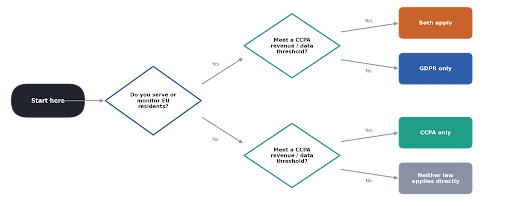
A useful rule of thumb repeated across the compliance industry: building to GDPR’s standard covers roughly 60–80% of what CCPA also requires, because both laws overlap on transparency, access, and deletion. The remaining gap is almost entirely CCPA-specific plumbing — the opt-out links, the sensitive-data limitation control, and the 2026 audit and risk-assessment obligations that GDPR has no equivalent for.
GDPR vs CCPA and Penalties Enforcement in 2026
| Right | GDPR | CCPA/CPRA |
|---|---|---|
| Standard maximum | €10M or 2% of global turnover (lower tier) | $2,500 per unintentional violation |
| Severe maximum | €20M or 4% of global turnover (higher tier) | $7,500 per intentional violation |
| Private lawsuits | Limited; mainly through national court systems | Yes — tied to breaches of unencrypted/unredacted data |
| Recent notable action | Meta — €1.2B (2023); LinkedIn — €310M (2024) | Tractor Supply — $1.35M; American Honda — $632.5K (2025) |
Cumulative GDPR fines have passed €5.8 billion since 2018, and enforcement coordination between EU regulators has tightened, closing off some of the jurisdiction-shopping that used to soften penalties. On the CCPA side, the newly independent CPPA is now issuing settlements on its own authority rather than routing everything through the state Attorney General, and it reports hundreds of open investigations.
Designing Your Consent and Cookie Flow
The opt-in vs. opt-out split isn’t just a legal detail — it dictates how your cookie banner, sign-up form, and account settings actually get built. Teams that design one flow and try to make it satisfy both laws usually end up with something that annoys EU users, under-protects California users, or both.
For EU traffic: consent has to come first
A GDPR-compliant banner has to let someone say no as easily as they say yes — equally sized “Accept” and “Reject” buttons, no pre-checked boxes, and no dark patterns that bury the reject option behind extra clicks. Non-essential cookies (analytics, ad pixels, most third-party embeds) can’t fire until the visitor actively agrees. Essential cookies — the ones that keep a cart or a login session working — don’t need consent, but they still need to be disclosed.
For California traffic: visibility matters more than a gate
CCPA doesn’t require a consent banner at all in the way GDPR does. What it requires is that a “Do Not Sell or Share My Personal Information” link (or a combined “Your Privacy Choices” link) is easy to find — typically in the footer — and that clicking it actually stops the sale or sharing of that visitor’s data going forward. Sites also need to honor the Global Privacy Control (GPC) browser signal as a valid opt-out, without making the visitor submit a separate request.
- Practical approach: Detect the visitor’s likely jurisdiction and serve the stricter GDPR-style gate to EU/EEA traffic, and the lighter CCPA-style footer link plus GPC support to everyone else.
- Tooling note: A consent management platform (CMP) that supports both IAB TCF (for GDPR) and the US Privacy/GPC signal removes most of the manual maintenance as new US state laws are added.
Beyond GDPR vs CCPA What Else Is Coming
GDPR vs CCPA get the most search volume, but neither law exists in isolation anymore. Roughly 20 US states now have their own comprehensive privacy statutes — Virginia, Colorado, Connecticut, Utah, and a growing list of others — and most of them borrow heavily from CCPA’s opt-out model while adding their own wrinkles around sensitive data, data broker registries, or minors’ data. A compliance program built only around “GDPR + CCPA” will still miss obligations in states like Colorado, which requires universal opt-out mechanism support on a stricter timeline than California originally did.
Outside the US, GDPR itself has become a template rather than an endpoint. Brazil’s LGPD, South Africa’s POPIA, and a wave of newer Middle Eastern and Asian data-protection laws all track GDPR’s structure closely enough that a well-built GDPR program is usually the fastest starting point for global expansion — but “closely” is not “identically,” and each one has at least one requirement (a local representative, a specific breach-notice window, a data-localization rule) that GDPR doesn’t.
Where to go next – If your company is US-based with a small EU footprint, start with a GDPR-grade consent and rights-request process, then layer on CCPA’s opt-out links and the state-by-state variations as your user base grows. If you’re EU-first and expanding into the US, the reverse is true: your GDPR program is likely already stronger than CCPA requires, and the gap-filling work is almost entirely California- and state-specific.
Where Companies Get This Wrong
- Copy-pasting GDPR language: Treating CCPA notices as a smaller version of a GDPR privacy policy instead of adding the required opt-out and sensitive-data links.
- Ignoring the CPRA rewrite: CCPA and CPRA use different thresholds and different rights — using pre-2023 CCPA material without the CPRA updates leaves real gaps.
- Assuming “we don’t sell data” is enough: Advertising and analytics integrations that pass identifiers to a third party often count as a “sale” or “share” under CCPA, even without money changing hands.
- Missing the 2026 CCPA updates: The 2026 rules on cybersecurity audits, risk assessments, and ADMT notices apply on a rolling timeline — treat this as a standing compliance item, not a one-time project.
- Forgetting GDPR’s transfer restrictions: GDPR’s cross-border transfer rules (adequacy decisions, SCCs, the EU-US DPF) have no CCPA counterpart — a compliant CCPA program can still violate GDPR’s transfer regime.
✎ Worth Remembering –A quick AI-generated summary will tell you GDPR is opt-in and CCPA is opt-out — but it won’t tell you whether your specific ad pixels count as a “sale” under CCPA, or whether your EU data flows still need Standard Contractual Clauses after last year’s architecture change. That verification step is where the real compliance risk lives.
A Practical Dual-Compliance Checklist
✓ Map where EU and California users’ data actually flows — don’t assume based on where your company is incorporated.
✓ Build consent flows to GDPR’s opt-in standard globally, then layer CCPA’s opt-out links on top for California traffic.
✓ Add a “Do Not Sell or Share My Personal Information” link and a sensitive-information limitation control, even if you don’t think you “sell” data.
✓ Confirm Standard Contractual Clauses or another valid transfer mechanism for any EU data leaving the EEA.
✓ Run (or schedule) the CCPA-required risk assessments and cybersecurity audit if your revenue and data-processing volume meet the 2026 thresholds.
✓ Re-test both programs whenever you add a new integration, ad pixel, or AI feature that touches personal data.
Official Sources & Further Reading
GDPR vs CCPA and FAQs
Is CCPA basically GDPR for California?
Not quite. CCPA/CPRA is sometimes called “GDPR lite,” but the two run on opposite consent models and CCPA only applies once a business crosses a revenue or data-volume threshold — GDPR has no such floor.
If we're GDPR compliant, are we automatically CCPA compliant?
No. GDPR compliance covers much of the same ground — transparency, access, deletion — but CCPA still requires its own opt-out links, sensitive-data controls, and (from 2026) specific risk-assessment and audit obligations.
Does CCPA apply to small businesses?
Only if they meet one of the three thresholds: roughly $25M+ in annual revenue, 100,000+ CA consumers’ or households’ data bought/sold/shared per year, or 50%+ of revenue from selling personal information. Many small companies fall outside CCPA entirely.
What counts as a “sale” of data under CCPA?
Broader than most teams expect — sharing identifiers with an ad network or analytics partner in exchange for services can qualify, even without a direct cash payment.
What's new in the 2026 CCPA rules?
Mandatory cybersecurity audits and formal risk assessments for higher-risk processing became effective January 1, 2026, with ADMT opt-out and access notices for significant decisions following January 1, 2027.
Do we need a consent banner for California visitors too?
Not in the GDPR sense. CCPA doesn’t require blocking cookies until someone agrees — it requires an easy-to-find opt-out link and support for the Global Privacy Control browser signal. Many sites still show a lighter banner for CA visitors as a UX convenience, not a legal requirement.