
How to NIST AI RMF implementation: A Practical Guide
NIST AI RMF implementation : Most AI/ML teams don’t need to be convinced that the NIST AI Risk Management Framework exists — someone on the security questionnaire, the board, or the enterprise sales team has already brought it up. The harder question is what “implementing” it actually looks like once you’re past the introduction. The framework itself won’t tell you: it’s deliberately descriptive rather than prescriptive, which is exactly why so many programs stall out after the policy is written. This guide walks through the practical sequence — who owns what, what gets built first, and where most implementations quietly lose momentum — for teams that are past the “what is this” stage and ready to actually run it.
Quick idea: – NIST AI RMF implementation means operationalizing four functions — Govern, Map, Measure, and Manage — across every AI system you build, buy, or embed. It has no certification and no fixed checklist. Most organizations do well on Govern and Map (policies on paper) and stall on Measure, because testing and benchmarking require infrastructure, not just documentation.
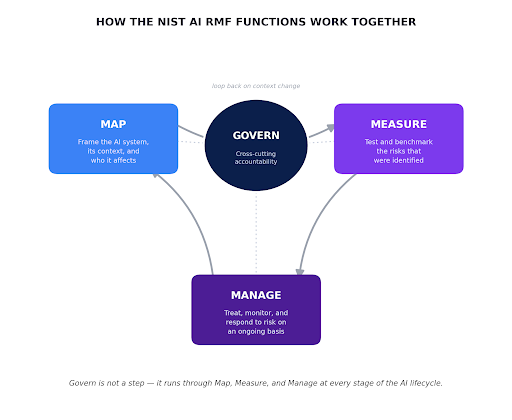
- Govern isn’t step one and done — it’s cross-cutting and runs through the other three functions continuously, which is different from how most compliance projects are structured.
- The team is smaller than people assume: an accountable risk owner, a compliance practitioner, and a technical lead cover most of it — sometimes one person holds two of those hats.
- Measure is where implementations quietly die. Teams write the policy, build the inventory, then never stand up the testing and monitoring infrastructure Measure actually requires.
Important context: – B4Q Assurance works with AI/ML product companies operationalizing the NIST AI RMF — from the initial system inventory through building the evidence trail auditors and enterprise buyers actually ask for, whether that program stands alone or feeds into an ISO/IEC 42001 AI management system.
What "Implementing" the Framework Actually Means
The NIST AI RMF Core is organized into four functions — Govern, Map, Measure, and Manage — each broken into categories and subcategories that describe an outcome, not a task. NIST is explicit that these aren’t a checklist to complete in order: after Govern is in place, most organizations move to Map and then cycle into Measure and Manage, looping back to Map whenever the context changes — a new use case, a new data source, a new regulation. Implementation, in other words, is a repeatable process you run continuously across the AI lifecycle, not a project with a finish line.
| Function | What It Covers | Typical Output |
|---|---|---|
| Govern | Cross-cutting policy, accountability, and culture for AI risk across the org | AI governance charter, escalation path, named risk owner |
| Map | Context for a specific AI system — its use case, stakeholders, and likely impacts | System inventory plus a context document per system |
| Measure | Testing, benchmarking, and evaluation of the risks identified in Map | Bias/robustness test results, a live metrics dashboard |
| Manage | Treating, monitoring, and responding to risk once it's been measured | Risk register, monitoring plan, incident and decommission process |
Before You Start: The Readiness Assessment
Before touching any of the four functions, get a straight answer to “where does AI already exist in this organization.” That means inventorying every AI system in production, in pilot, and embedded inside vendor tools or SaaS platforms you didn’t build — foundation model APIs included. For each one, note whether any risk documentation, testing records, or governance already exists. This produces what NIST calls a Current Profile: a snapshot of where your practices stand today against the four functions, which becomes the baseline for a Target Profile you’re implementing toward.
Worth knowing: – The framework keeps expanding through profiles rather than a version 2.0. NIST added a Generative AI Profile in July 2024, published a preliminary Cyber AI Profile in December 2025 that bridges AI risk to the NIST CSF 2.0, and released a concept note in April 2026 for a critical-infrastructure profile. An agent-focused profile is expected in late 2026. Build your base implementation in a modular way — a clear system inventory and a documented Current Profile — so a new profile is a layer you add, not a program you rebuild.
The Implementation Roadmap
- Establish governance roles — Name an AI risk owner senior enough to pause a deployment, plus a compliance practitioner and a technical lead. A nominal owner without real authority is a common audit finding — the role has to carry weight, not just a title.
- Inventory and classify AI systems — List every system from the readiness assessment and classify each by criticality and potential for harm. This tells you which systems get mapped, measured, and managed first — you will not do all of them at once.
- Define risk appetite and principles — Document tolerance for risk in areas like fairness, privacy, safety, and robustness before you start testing against it. Without this, Measure has nothing to benchmark against.
- Build measurement infrastructure — Stand up the evaluation pipeline — bias testing, robustness checks, red-teaming for generative systems — tied to the highest-priority systems from step 2. This is the step most programs skip in practice.
- Set up risk treatment and monitoring — For each measured risk, decide to avoid, mitigate, transfer, or accept it, and put post-deployment monitoring, an appeal/override path, and an incident process in place.
- Close the loop back into Govern — Feed what Measure and Manage surface back into policy and the Current Profile. This is what keeps the framework from calcifying into a document nobody reopens.
| Role | Responsibility | Typical Title |
|---|---|---|
| AI risk owner | Accountable for the program; can pause or block a risky deployment | CISO, VP of AI, or Head of Risk |
| Compliance practitioner | Writes and maintains documentation, evidence, and the Current/Target Profiles | Compliance or GRC manager |
| Technical lead | Builds measurement infrastructure and runs the actual evaluations | ML/AI engineering lead |
Common Mistakes We See
- Treating Govern as a policy PDF instead of assigning it to someone with real authority to pause a launch
- Writing risk policy before the system inventory is finished, so the paperwork doesn’t match what’s actually deployed
- Getting Govern and Map done, then quietly dropping Measure because nobody owns the testing infrastructure
- Assuming NIST AI RMF alignment alone satisfies the EU AI Act, sector regulators, or a specific customer’s AI questionnaire
- Building a static, one-time implementation instead of a continuous process that loops back to Map when context changes
Worth knowing: – NIST AI RMF 1.0 has no formal certification — organizations demonstrate implementation through self-assessment, third-party audit, and Current/Target Profile documentation, not a certificate. For a certifiable AI governance standard, ISO/IEC 42001:2023 is the relevant option, and many organizations use the NIST AI RMF as the day-to-day risk-management operating model that sits inside an ISO 42001 AI management system.
What Happens If a Function Gets Skipped
| Function Skipped | What It Looks Like in Practice |
|---|---|
| Govern | No one has the authority to pause a risky deployment before it ships |
| Map | Risk gets assessed generically instead of against the specific system's actual context and users |
| Measure | "Responsible AI" claims exist with no test results or metrics behind them |
| Manage | Incidents become ad hoc firefighting instead of a documented, repeatable response |
How Long This Actually Takes
Timelines vary more with organizational readiness than with company size. A single flagship AI system with an engaged risk owner can reach foundational Govern-Map-Measure-Manage coverage faster than a sprawling, uncoordinated AI footprint at a much larger company.
| Starting Point | Typical Timeline |
|---|---|
| Foundational adoption for one flagship AI system | 3–6 months |
| Organization-wide integration across all AI systems | 12–24 months |
| Layering onto an existing ISO 27001, SOC 2, or ISO 42001 program | Faster — governance structures and evidence habits already exist |
Why This Is Worth Doing Properly
Beyond satisfying a vendor questionnaire, a working implementation gives you something you’ll actually use: a current, defensible answer to “what could this system get wrong, and who’s responsible for catching it” — instead of reconstructing that answer under pressure the first time a regulator, auditor, or enterprise customer asks for it directly.
How B4Q Assurance Helps
B4Q Assurance works with AI/ML product companies to inventory AI systems, assign Govern accountability that will actually hold up under audit, and build the Measure and Manage infrastructure most in-house teams don’t have time to stand up — whether that’s a standalone NIST AI RMF implementation or one layered into an ISO 42001 AI management system.
NIST AI RMF implementation & Resources
- NIST AI RMF 1.0 (NIST AI 100-1) — the official framework document
- NIST AI RMF Playbook — suggested actions mapped to each subcategory
- NIST Generative AI Profile (NIST AI 600-1) — supplementary guidance for LLMs and generative systems
NIST AI RMF implementation & FAQs
Is implementing the NIST AI RMF mandatory?
No — it’s voluntary at the federal level for private industry. It’s become the de facto reference point regulators, enterprise buyers, and sector rules point to, and it’s effectively expected for federal contractors, but there’s no legal requirement to adopt it outside those contexts.
How long does implementation take?
For a single flagship system with a clear owner, 3–6 months is typical. Organization-wide coverage across every AI system generally takes 12–24 months, largely because Measure requires building evaluation infrastructure most teams don’t already have.
Do we need ISO 42001 as well?
Not necessarily, but it’s common. NIST AI RMF has no certification of its own; ISO 42001 does. Many organizations run NIST AI RMF as the operating model
What's the minimum team required?
Three roles: an accountable AI risk owner, a compliance practitioner, and a technical lead. Smaller organizations often combine the compliance and technical roles into one person — the risk owner is the one role that shouldn’t be compressed.
Are we a controller for our own AI systems, or a processor for a customer's?
Often both, depending on the system — much like the controller/processor distinction in privacy frameworks. You’re typically accountable for your own product’s AI decisions, and more of a processor when your platform runs a customer’s data through models on their instructions.