
How to Get ISO 27701 Certified: A Step-by-Step Guide
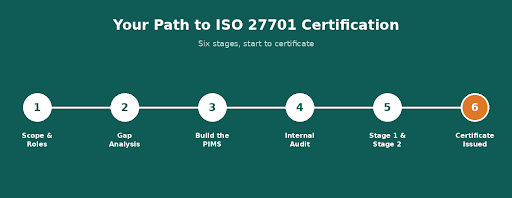
ISO 27701 certification process : How do we actually get this certified” is usually the second question, right after “what is ISO 27701.” The standard itself reads reasonably clearly, but turning it into an actual certificate on the wall involves a specific sequence — scoping, a gap analysis, building the management system, running it long enough to generate evidence, and then two rounds of external audit before a certification body will sign off. Skip a step, or do them out of order, and it shows up as findings during the audit rather than as a smooth process. This guide walks through that sequence stage by stage, what each one actually involves, and roughly how long the whole thing tends to take.
Quick idea: – ISO 27701 certification follows the same two-stage audit model as ISO 27001 — Stage 1 checks whether your Privacy Information Management System (PIMS) is designed correctly, Stage 2 checks whether it’s actually being followed. Since the 2025 edition made ISO 27701 a standalone standard, you can now run this process on its own or as an integrated audit alongside ISO 27001 — the stages below are the same either way, just with a different starting point.
- It’s a sequence, not a checklist you can reorder: gap analysis has to come before you write policy, and internal audit has to come before the certification body shows up.
- Most of the calendar time is evidence, not paperwork: auditors want to see the PIMS operating for a period of time, not just documents that were written the week before Stage 1.
- Certification isn’t the finish line: it’s a three-year cycle with annual surveillance audits, so the system needs to keep running after the certificate is issued.
Important context: – B4Q Assurance guides SaaS companies and data processors through every stage of this process — from the initial gap analysis through Stage 1 and Stage 2 audits — whether ISO 27701 is being pursued standalone under the 2025 edition or integrated with an existing ISO 27001 program.
The Certification Journey, Stage by Stage
There’s some variation between certification bodies in exactly how these stages are packaged, but the underlying sequence is consistent. Here’s the shape of it end to end.
| Stage | What happens | Typical owner |
|---|---|---|
| 1. Scope & roles | Define what the PIMS covers, and who is controller vs processor for each dataset | Privacy lead / DPO |
| 2. Gap analysis | Compare current practice against ISO 27701's controller and processor controls | Privacy lead + consultant |
| 3. Build the PIMS | Write policies, assign control owners, stand up records of processing | Cross-functional team |
| 4. Run & internal audit | Operate the PIMS long enough to generate real evidence, then self-audit it | Internal audit / compliance |
| 5. Stage 1 & Stage 2 audit | External auditor reviews design, then tests operating effectiveness | Certification body |
| 6. Certificate issued | Three-year cycle begins, with annual surveillance audits | Certification body |
Step 1: Define Scope and Controller/Processor Roles
Before any policy gets written, decide what’s actually being certified. Certifying the whole organization is sometimes the right call, but for a first certification, scoping to the product, business unit, or data flows that matter most to customers is often faster and cleaner. Trying to cover everything at once tends to slow the whole project down without adding much credibility.
This is also where the controller-versus-processor question has to get answered for real, dataset by dataset — not as a general statement, but mapped to each category of personal data the organization actually touches. ISO 27701 splits its controls by role, so this decision shapes almost everything that follows.
Step 2: Run the Gap Analysis
The gap analysis compares what the organization currently does against ISO 27701’s control set — 31 controls for the controller role, 18 for the processor role, on top of the security controls inherited from an ISMS. The output isn’t a pass/fail score; it’s a prioritized list of what’s missing, what’s partially in place, and what already exists but isn’t documented as evidence.
Teams that skip this step, or rush it, tend to end up writing policies that don’t reflect what the organization actually does — which is exactly what an auditor notices first.
Step 3: Build the Privacy Information Management System
This is where the gap list turns into actual policy, process, and ownership. In practice that means: assigning a control owner for every gap identified, documenting records of processing activities, defining how data subject requests and breach notifications actually get handled operationally, and folding privacy risk into whatever risk register the organization already runs.
Reusing what already exists matters here. Organizations with an ISO 27001 ISMS in place can extend existing risk management and internal audit processes rather than building parallel ones — which is the main reason integrating with ISO 27001 is still the faster path for companies that already have it.
Step 4: Operate the System and Run an Internal Audit
A PIMS that exists only on paper doesn’t pass Stage 2. Auditors expect to see the system running for long enough to generate genuine evidence — processing records being updated, access reviews happening on schedule, a data subject request or two actually being handled through the documented process. An internal audit, done honestly before the external one, is what catches the gaps a certification body would otherwise flag first.
| Signal an auditor looks for | What it's really testing |
|---|---|
| Records of processing updated recently | Whether the PIMS is a living system or a one-time document exercise |
| Named owner for each control | Whether accountability is actually assigned, not just implied |
| Evidence of a handled data subject request | Whether the process works in practice, not just on paper |
| Internal audit findings with a follow-up trail | Whether issues get fixed, or just logged and forgotten |
Step 5: Stage 1 and Stage 2 External Audits
Stage 1 is a documentation and design review — the auditor checks whether the PIMS, as designed, would actually satisfy ISO 27701 if it were operating correctly. It usually surfaces gaps that are fixable before Stage 2, which is exactly the point of splitting the audit in two.
Stage 2 tests whether the system is actually operating the way Stage 1 said it would — interviews, evidence sampling, and direct observation of controller- and processor-specific controls, records handling, and breach response. Minor nonconformities at this stage are normal and correctable; the certification body will typically outline a timeline to close them rather than failing the audit outright.
Step 6: Certification and the Three-Year Cycle
Once Stage 2 closes out cleanly, the certificate is issued for a three-year cycle. That’s not the end of the work — Year 2 and Year 3 bring surveillance audits that check the PIMS is still operating, and Year 4 is a full recertification audit that restarts the cycle.
Worth knowing: –The overall timeline varies a lot by starting point. Organizations already running an ISO 27001 ISMS often get through the full process in a few months, since most of the risk management and audit machinery already exists. Starting from scratch under the standalone 2025 route generally takes closer to what a first ISO 27001 implementation takes — often somewhere in the 6–12 month range, depending on scope and how mature current data practices already are.
Choosing a Certification Body
Not every certification body issues ISO 27701 certificates, and among those that do, accreditation and sector experience vary. It’s worth confirming accreditation under ISO/IEC 17021-1 and 27006-1 specifically for privacy, checking whether they have experience auditing organizations of a similar size and role (controller vs processor), and getting a clear quote that separates Stage 1, Stage 2, and the ongoing surveillance-audit cost — not just the headline certification fee.
Common Mistakes We See
- Writing policy before the gap analysis is finished, so the documentation doesn’t match reality
- Scoping the certification too broadly for a first attempt, which slows everything down
- Treating Stage 1 as a formality instead of using it to fix design gaps before Stage 2
- Letting the PIMS go quiet after certification, then scrambling before the Year 2 surveillance audit
- Assuming the 2025 standalone edition means less audit rigor — the two-stage process didn’t change
How B4Q Assurance Helps
B4Q Assurance works alongside SaaS companies and data processors through the entire ISO 27701 journey — scoping and gap analysis, building out the PIMS, preparing for Stage 1 and Stage 2 audits, and keeping the system audit-ready through ongoing surveillance cycles, whether pursued standalone under the 2025 edition or integrated with an existing ISMS.
Resources
- ISO/IEC 27701:2025 — official standard listing
- ISO/IEC 17021-1 — requirements for certification bodies
FAQs
How long does ISO 27701 certification actually take?
Typically a few months for organizations already ISO 27001-certified, and closer to 6–12 months for a standalone effort starting from scratch — scope, team size, and how mature current data practices already are all move that number.
Do we need ISO 27001 first?
Not since the 2025 edition. ISO 27701 can be certified standalone, though integrating it with an existing ISO 27001 ISMS is still faster if you already have one in place.
What happens if we fail Stage 2?
Outright failure is uncommon. Minor nonconformities are addressed with a corrective action plan and a follow-up review; major nonconformities can delay certification until they’re resolved and re-verified.
How much evidence-generation time do we need before Stage 2?
There’s no fixed rule, but auditors generally want to see the PIMS operating — not just documented — for a meaningful stretch, often a few months, so processes have actually produced real records.
Does certification ever expire?
The certificate itself is valid for three years, with annual surveillance audits in between, followed by a full recertification audit at the three-year mark to start the next cycle.