
NIST CSF 2.0 What Changed and Why It Matters
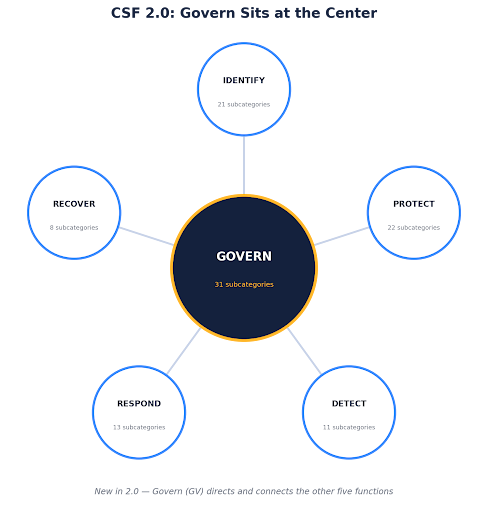
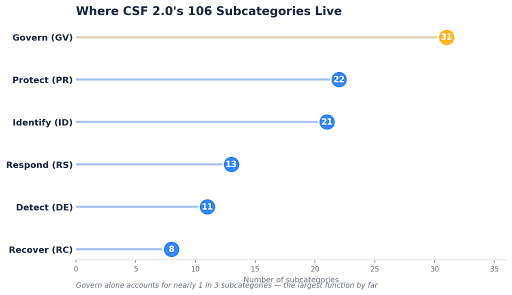
⚡ QUICK SUMMARY – NIST CSF 2.0 changes on February 26, 2024 — the first major update since the framework launched in 2014. The headline change is a new sixth function, Govern, which consolidates cybersecurity governance, risk strategy, and supply chain oversight into a dedicated 31-subcategory function. The framework now spans 6 functions, 22 categories, and 106 subcategories (down slightly from 1.1’s 23 categories and 108 subcategories), and it explicitly applies to organizations of any size or sector, not just critical infrastructure. In 2026, Govern has become the framework’s most consequential piece: it maps directly to NIS2’s management-body accountability requirements and aligns with 51% of new US state cybersecurity bills passed in 2025.
A Decade in the Making
The NIST CSF 2.0 changes Cybersecurity Framework launched in 2014 as guidance for U.S. critical infrastructure operators, was refreshed modestly as CSF 1.1 in 2018, and then sat untouched for six more years while ransomware, cloud-native architecture, and supply chain attacks reshaped the threat landscape. NIST opened the CSF 2.0 revision process in February 2022, ran two public draft comment periods that together drew more than 2,500 responses, and published the final version on February 26, 2024.
The title itself changed — from “Framework for Improving Critical Infrastructure Cybersecurity” to simply “The NIST Cybersecurity Framework (CSF) 2.0” — signaling that it now applies to universities, hospitals, manufacturers, financial institutions, and small businesses just as much as power grids and pipelines.
The Govern Function: CSF 2.0's Headline Change
CSF 1.1 had five functions — Identify, Protect, Detect, Respond, Recover — all focused on operational security activity. What was missing was explicit guidance on the organizational and leadership structures that make those activities work: how cybersecurity decisions get made, who is accountable, how risk appetite is set, and how security connects to business strategy. Govern fills that gap directly.
▸ 6 categories — Organizational context, risk management strategy, and cybersecurity supply chain risk management all now report through Govern rather than being scattered across other functions.
▸ 31 subcategories — Nearly one in three CSF 2.0 subcategories now sits inside Govern — more than any other single function.
▸ Supply chain reassigned — Vendor and third-party risk moved from ID.SC (under Identify) to GV.SC (under Govern) — repositioning supply chain risk as an executive-level governance concern, not just an inventory task.
Structure at a Glance: 1.1 vs. 2.0
| Element | CSF 1.1 (2018) | CSF 2.0 (2024) |
|---|---|---|
| Core functions | 5 — Identify, Protect, Detect, Respond, Recover | 6 — adds Govern |
| Categories | 23 | 22 |
| Subcategories | 108 | 106 |
| Intended scope | Critical infrastructure sectors | Any organization, any size or sector |
| Supply chain risk | Under Identify (ID.SC) | Under Govern (GV.SC) |
| Informative references | Fixed appendix in the document | Online CPRT catalog, continuously updated |
| Profiles | Basic Current/Target concept | Formalized Organizational + Community Profiles |
Profiles and Tiers, Reframed
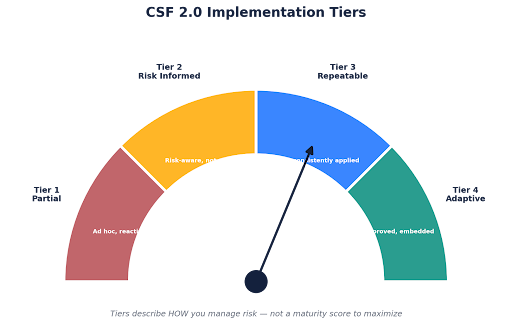
NIST CSF 2.0 changes keeps the four Implementation Tiers from 1.1, but changes how they’re meant to be read. In 1.1, tiers were often treated as a maturity ladder — higher was simply better. CSF 2.0 is explicit that tiers describe how an organization integrates cybersecurity risk management into its broader risk practices, not a score to maximize. A Tier 2 organization isn’t failing; it may be operating exactly where its size and risk environment call for.
Alongside tiers, CSF 2.0 formalizes Organizational Profiles (Current and Target) and introduces Community Profiles — published baselines for shared sectors like financial services and small network providers — that give organizations a ready-made starting point instead of building a Target Profile from a blank page.
How NIST CSF 2.0 changes Maps to Other Frameworks
| Framework | Mapping status | What overlaps |
|---|---|---|
| ISO/IEC 27001 | Official NIST mapping available | ISMS risk treatment and controls map closely to Identify/Protect |
| SOC 2 | Community-derived, not official | Trust Services Criteria align loosely; document alignment yourself for auditors |
| HIPAA Security Rule | Official NIST mapping available | Administrative, physical, and technical safeguards |
| PCI DSS | Official NIST mapping available | Access control and protection outcomes |
| EU NIS2 Directive | No official NIST mapping | Govern aligns closely to NIS2's management-body accountability duties |
| EU DORA | No official NIST mapping | ICT risk management and third-party oversight overlap with Govern |
Alongside tiers, CSF 2.0 formalizes Organizational Profiles (Current and Target) and introduces Community Profiles — published baselines for shared sectors like financial services and small network providers — that give organizations a ready-made starting point instead of building a Target Profile from a blank page.
⚠ COMMON TRAP – Treating NIST CSF 2.0 changes as a checklist to tick off. CSF is an outcomes-based framework — the subcategories describe what good looks like, not a fixed list of controls to implement verbatim. Teams that map CSF 1.1 controls straight across to 2.0 often miss that the biggest change isn’t a control at all; it’s the governance layer that now has to sit above everything else.
Why This Matters Right Now
▸ It’s becoming the NIS2 connector — The Govern function maps directly to NIS2’s “management bodies” accountability requirements. Organizations that implemented Govern early found themselves ahead of the curve as NIS2 enforcement ramped up.
▸ State legislatures are borrowing its language — A 2026 UC Berkeley CLTC analysis of 99 state cybersecurity bills enacted in 2025 found that 51% of new statutory rules align to the Govern function — confirming it as the framework’s most regulator-relevant piece.
▸ Boards now expect governance reporting, not just controls — In 2024 the question was “how do we implement NIST?” In 2026 it’s “how do we report on it?” Boards, investors, and regulators expect security leaders to translate technical posture into governance and financial terms — which is exactly what Govern was built to support.
Migrating From CSF 1.1 to 2.0
Start with Govern, not a control-by-control comparison. Establish accountability, risk appetite, and strategic context first — it makes every other function more focused.
Re-map your existing supply chain risk controls from ID.SC to GV.SC, and confirm they now have executive-level visibility, not just an inventory owner.
Pull an existing Community Profile for your sector if one exists, rather than building a Target Profile from scratch.
Use the online CPRT catalog for informative references instead of relying on an old 1.1 appendix — mappings are updated continuously.
Treat Tier selection as a fit exercise, not a maturity contest — Tier 2 or 3 is a realistic, defensible target for most organizations.
If you’re already ISO 27001 or PCI DSS aligned, start from NIST’s official crosswalks rather than remapping controls from zero.
✦ WORTH REMEMBERING – A quick search summary will tell you CSF 2.0 added a Govern function — but it won’t tell you that Govern alone now accounts for nearly a third of the entire framework, or that your specific supply chain controls need to move up to an executive reporting line, not just a new label. That re-mapping work is where most transition projects actually stall.
Official Sources & Further Reading
Start with Govern, not a control-by-control comparison. Establish accountability, risk appetite, and strategic context first — it makes every other function more focused.
Re-map your existing supply chain risk controls from ID.SC to GV.SC, and confirm they now have executive-level visibility, not just an inventory owner.
Pull an existing Community Profile for your sector if one exists, rather than building a Target Profile from scratch.
Use the online CPRT catalog for informative references instead of relying on an old 1.1 appendix — mappings are updated continuously.
Treat Tier selection as a fit exercise, not a maturity contest — Tier 2 or 3 is a realistic, defensible target for most organizations.
If you’re already ISO 27001 or PCI DSS aligned, start from NIST’s official crosswalks rather than remapping controls from zero.
NIST CSF 2.0 changes & Frequently Asked Questions
When was NIST CSF 2.0 released?
February 26, 2024. It’s the first major revision since the framework’s original 2014 release, following a light update to version 1.1 in April 2018.
Is NIST CSF 2.0 mandatory?
No. CSF remains voluntary. It becomes indirectly mandatory when a contract, regulation, or insurer specifically requires it, or when it’s used as the reference framework for a sector-specific rule.
What is the Govern function?
The sixth and newest CSF function. It covers organizational context, risk management strategy, roles and responsibilities, policy, oversight, and supply chain risk management — 31 subcategories in total.
How many subcategories does CSF 2.0 have?
106, across 22 categories and 6 functions — down slightly from CSF 1.1’s 108 subcategories and 23 categories, reflecting consolidation alongside Govern’s addition.
Do I need to formally transition from CSF 1.1 to 2.0?
There’s no enforced deadline, but NIST is no longer updating 1.1 materials, and most current mappings, tools, and profiles are built for 2.0 — so most organizations are migrating as part of their normal review cycle.