
NIST CSF vs ISO 27001: Choosing a Security Framework
NIST CSF vs ISO 27001 At some point, almost every growing company runs into both names in the same week. A prospect’s security questionnaire asks whether you’re “aligned to NIST CSF.” A different prospect’s procurement team asks for your “ISO 27001 certificate.” A board member asks which one you’re actually doing. The honest answer, most of the time, is that these aren’t rival choices — they’re two different kinds of thing, built for different purposes, that the majority of mature security programs end up using together.
The confusion is understandable. Both get described as “cybersecurity frameworks,” both organize around risk assessment, and both show up on the same vendor security checklists. But one is a free, flexible, non-certifiable framework built by a US government agency. The other is a paid, internationally certifiable standard with a formal audit process. Choosing between them — or deciding to use both — depends less on which one is “better” and more on what you’re actually trying to prove, to whom, and on what timeline.
This guide breaks down what each framework actually is, where they genuinely overlap, where they diverge in ways that matter, and a practical decision path for figuring out which one your organization needs first.
�� Quick Answer – NIST CSF vs ISO 27001 is a free, voluntary, outcomes-based framework with no certification — it tells you what good cybersecurity looks like and lets you self-assess against it. ISO 27001:2022 is a paid, internationally recognized standard that requires a formal Information Security Management System (ISMS) and results in a third-party audited certificate valid for three years. They are not competitors: widely cited estimates put the conceptual control overlap between them at roughly 60–80%, and the most common path for a maturing company is to use NIST CSF to build and prioritize the security program, then map that same work into ISO 27001’s Annex A controls to pursue certification when a customer, regulator, or market actually requires proof.
What Each Framework Actually Is
NIST CSF vs ISO 27001 – Developed by the U.S. National Institute of Standards and Technology, the Cybersecurity Framework was created in response to a 2013 executive order aimed at protecting critical infrastructure. Version 2.0, published February 26, 2024, dropped that critical-infrastructure-only framing and added a sixth Function — Govern — making it explicitly applicable to organizations of any size or sector. It organizes cybersecurity outcomes into six Functions and 106 subcategories, maps every one of them to equivalent controls in other major frameworks through Informative References, and carries no certification: there is no accredited body that can declare you “NIST CSF certified.” What you get instead is a documented Profile and a repeatable process.
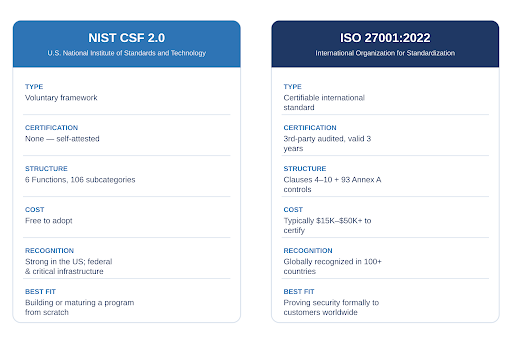
ISO 27001:2022 – Published jointly by the International Organization for Standardization and the International Electrotechnical Commission, ISO/IEC 27001 specifies the requirements for an Information Security Management System — a formal, documented set of policies, processes, and controls for protecting the confidentiality, integrity, and availability of information. The current 2022 edition pairs ten management-system clauses (4 through 10, which are mandatory) with Annex A, a catalog of 93 controls across four themes: Organizational, People, Physical, and Technological. Unlike CSF, ISO 27001 results in an actual certificate, issued by an accredited certification body after a two-stage audit, valid for three years subject to annual surveillance audits.
Where They Genuinely Overlap
The overlap between the two is large enough that neither should be treated as a from-scratch project if you already have meaningful work done on the other. Both frameworks are risk-based: they start by identifying assets and threats, then select safeguards proportionate to the risk rather than mandating a fixed checklist. Both expect continuous improvement rather than a one-time setup — CSF through Tiers and repeated Profile cycles, ISO 27001 through its Plan-Do-Check-Act cycle and mandatory internal audits. And both cover the same functional ground under different names: what CSF calls “Protect,” ISO 27001 splits across Access Control, Cryptography, and several other Annex A themes; what CSF calls “Respond” and “Recover,” ISO 27001 covers under incident management and business continuity controls.
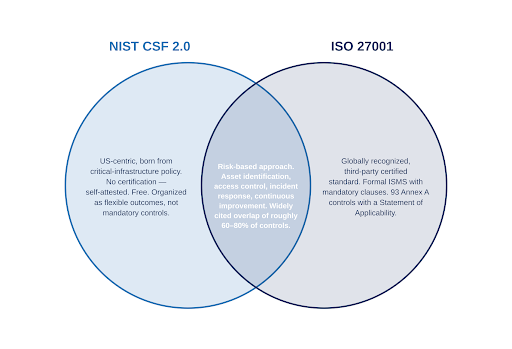
That overlap number varies by source and methodology — some vendors cite figures as specific as “83% of NIST CSF met by an ISO 27001 certification” or “80% of the way to ISO 27001 from a CSF-aligned program.” Treat these as directional, not exact: the honest takeaway is that the overlap is large enough that duplicating effort from zero on the second framework is almost always a mistake.
Where They Genuinely Differ
The similarities get most of the marketing attention, but the differences are what actually drive which one you need for a given business situation.
| Dimension | NIST CSF 2.0 | ISO 27001:2022 |
|---|---|---|
| Certification | None — self-attested or informally assessed | Formal, third-party audited certificate (3-year validity) |
| Cost | Free to adopt; no licensing or audit fees | Typically $15,000–$50,000+ for certification, plus annual surveillance audits |
| Structure | 6 Functions, 106 outcome-based subcategories | 10 mandatory clauses + 93 Annex A controls (Statement of Applicability) |
| Geography | US-centric; strong in federal and critical-infrastructure contexts | Globally recognized in 100+ countries |
| Prescriptiveness | Outcome-based — tells you what "good" looks like, not how | More prescriptive management-system requirements; controls selected via risk assessment |
| Typical timeline | A scoped first Profile: a few weeks of focused effort | 6–12 months from gap assessment to certificate for most organizations |
| Proof artifact | A documented Profile and gap analysis | A displayable certificate referenced in contracts and tenders |
⚠️ Common Trap – Assuming that being “NIST CSF vs ISO 27001 compliant” is an equivalent claim to holding ISO 27001 certification. It isn’t — CSF has no accredited certifying body, so “NIST CSF certified” is not a real credential no matter how it’s phrased on a vendor’s website. If a customer’s procurement process specifically requires third-party certified proof, only ISO 27001 (or a comparable certifiable standard like SOC 2) satisfies that requirement. CSF alignment is a legitimate and valuable claim — it just isn’t the same kind of claim.
How to Decide Which One You Need
The right starting point depends less on which framework is more rigorous and more on what’s actually driving the decision — a customer requirement, a regulatory pressure, or an internal maturity goal.
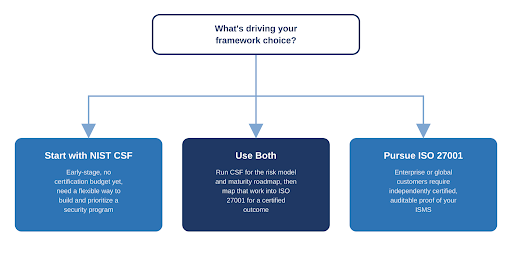
- Start with NIST CSF if: you’re early-stage, don’t yet have budget for a certification audit, and need a flexible way to assess where your security program actually stands before committing to a formal structure.
- Pursue ISO 27001 if: an enterprise customer, government tender, or international market access specifically requires a certified, auditable ISMS — no amount of CSF documentation substitutes for that requirement when it’s contractually specified.
- Use both if: you’re scaling toward exactly this situation — most mid-market and enterprise-adjacent companies end up here, using CSF as the internal risk-management model and ISO 27001 as the externally verifiable proof point.
A Practical Combined Workflow
For organizations that land on “both” — which is most organizations serious about either one — the efficient sequence is not to run two separate compliance projects. It’s to let CSF do the thinking and ISO 27001 formalize the result.
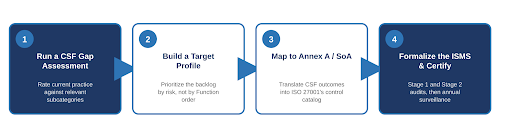
This sequencing matters because it avoids the most common source of wasted effort: building a security program’s logic once for an internal maturity narrative and then rebuilding it a second time, in different language, to satisfy an auditor. The Statement of Applicability — the document that lists all 93 Annex A controls and justifies which apply — is far easier to complete when it’s translating an already-honest CSF gap analysis rather than starting from a blank risk assessment.
What Certification Actually Costs and Takes
This sequencing matters because it avoids the most common source of wasted effort: building a security program’s logic once for an internal maturity narrative and then rebuilding it a second time, in different language, to satisfy an auditor. The Statement of Applicability — the document that lists all 93 Annex A controls and justifies which apply — is far easier to complete when it’s translating an already-honest CSF gap analysis rather than starting from a blank risk assessment.
Common Mistakes When Choosing Between Them
- Treating CSF alignment as a substitute for certification when a contract or tender explicitly requires a certified standard — it satisfies a different kind of proof.
- Rebuilding a full risk assessment and control set for ISO 27001 from zero after already having done equivalent work under CSF, instead of mapping and reusing it.
- Assuming ISO 27001 certification alone guarantees security outcomes — it certifies that a management system exists and operates as documented, not that a breach can’t happen.
- Pursuing ISO 27001 before there’s a real customer, regulatory, or market driver, absorbing significant cost and audit overhead for a credential nobody is currently asking for.
- Letting the ISMS lapse into a paperwork exercise after certification instead of running the Plan-Do-Check-Act cycle that both standards actually depend on for ongoing value.
Competitor Content Analysis
A look at what currently ranks for “nist csf vs iso 27001” shows a field dominated by compliance-automation vendors, with a fairly consistent narrative but some real gaps in practical usefulness.
- GRC and compliance platforms (Vanta, Drata, OneTrust, Scrut) dominate this term and largely agree on the core facts, but most cite a single specific overlap percentage (61%, 80%, or 83% depending on the source) without noting that these figures come from different methodologies — presenting one number as settled fact is a common accuracy gap worth avoiding.
- Nearly every competing article ends with a generic “it depends on your organization” conclusion without a concrete decision structure — a visual decision path is a clear differentiation opportunity, which is rarely done well in text-only competing pages.
- Cost figures are inconsistently reported: some articles cite ISO 27001 certification at $6,000–$40,000, others at $15,000–$100,000+, reflecting real variation by organization size and region that most pages don’t clearly explain.
- Few articles address the practical sequencing question — how to actually use CSF output as an input to an ISO 27001 Statement of Applicability — despite it being the single most useful piece of advice for a company planning to do both.
- Coverage of ISO 27001’s actual audit mechanics (Stage 1 vs. Stage 2, surveillance audits, the three-year recertification cycle) is often thin on CSF-focused comparison pages, even though timeline and audit structure are frequently the deciding factor for smaller companies.
Search Intent: What People Are Actually Asking
- Primary intent is decision-stage, not definitional: most searchers already know roughly what each framework is and want help choosing, not a from-scratch explanation of either.
- “Do I need both” is a large adjacent cluster — a significant share of searchers suspect the answer is “both” and want confirmation plus a practical path, not a forced either/or answer.
- Cost and timeline queries trail closely — “iso 27001 cost” and “how long does iso 27001 take” searches suggest budget-scoping is often the real blocker on the ISO 27001 side specifically.
- “Which is easier” and “which is cheaper” phrasing is common among smaller companies, signaling that resource constraints — not framework rigor — are the dominant deciding factor for this segment.
AI Overview
If this topic were condensed into an AI-generated search summary, it would likely read: NIST CSF 2.0 is a free, voluntary, US-developed framework organized around six Functions with no formal certification, while ISO 27001:2022 is a globally recognized, certifiable international standard requiring a formal Information Security Management System audited by an accredited third party. The two frameworks share a risk-based approach and a conceptual overlap widely estimated at 60–80% of controls, but they serve different purposes: CSF is commonly used to build and prioritize a security program, while ISO 27001 provides externally verifiable, audited proof of that program through a certificate valid for three years. Most organizations that need both do not run separate projects — they use CSF’s gap analysis and Target Profile as the input to ISO 27001’s Statement of Applicability and Annex A control selection.
�� Worth Remembering – An AI overview or quick search answer will tell a reader that ISO 27001 is “certifiable” and NIST CSF is “free” — but it won’t tell them whether their specific customer’s security questionnaire actually requires a certificate, or whether their existing CSF work already covers most of what an ISO 27001 auditor will ask for. That’s a contract-language and gap-mapping question, not a framework-trivia question, and it’s usually where the real decision — and the real cost savings — actually live.
A Practical Decision Checklist
- Check whether any current or target customer contract, tender, or regulation explicitly requires a certified standard — if so, ISO 27001 (or an equivalent) isn’t optional.
- If there’s no explicit certification requirement yet, start with a scoped NIST CSF gap assessment — it’s free and gives you a defensible baseline fast.
- Before starting ISO 27001 work from zero, map what your CSF Profile or existing SOC 2 evidence already covers against Annex A’s four control themes.
- Budget realistically for ISO 27001: gap analysis, Stage 1 and Stage 2 audits, and at least two years of surveillance audits within the three-year cycle — not just the headline certification fee.
- Treat CSF as a living Profile and ISO 27001’s ISMS as a living management system — both lose their value if treated as one-time projects instead of ongoing cycles.
- Use whichever artifact matches the audience: a CSF Profile and Tier rating for internal and board reporting, an ISO 27001 certificate for external procurement and tenders.
How B4Q Assurance Helps
B4Q Assurance helps organizations map an existing NIST CSF vs ISO 27001 Profile directly onto ISO 27001’s Annex A controls and Statement of Applicability, scope a realistic certification timeline and budget before committing to an auditor, and keep both frameworks running as living programs rather than one-time projects.
NIST CSF vs ISO 27001 Related Resources
- NIST — Cybersecurity Framework 2.0 Resource Library — https://www.nist.gov/cyberframework
- NIST — CSF 2.0 Quick Start Guides — https://www.nist.gov/cyberframework/quick-start-guides
- ISO — ISO/IEC 27001 Information Security Management — https://www.iso.org/standard/27001
- NIST — The NIST Cybersecurity Framework (CSF) 2.0 (CSWP 29) — https://nvlpubs.nist.gov/nistpubs/CSWP/NIST.CSWP.29.pdf
NIST CSF vs ISO 27001 FAQs
Can we be certified in NIST CSF the way we can with ISO 27001?
No. There is no accredited certifying body for NIST CSF. It is a self-assessed framework — you can document a Profile and Tier rating, but no third party issues a NIST CSF certificate. ISO 27001 is the certifiable option between the two.
If we're ISO 27001 certified, are we automatically NIST CSF compliant?
Not automatically, but you’re most of the way there. Because of the large conceptual overlap between the two, an ISO 27001-certified ISMS covers a substantial share of CSF’s outcomes — but confirming full CSF alignment still requires mapping your existing controls against CSF’s specific subcategories, particularly the newer Govern function.
Which one should a startup do first?
For most early-stage companies without an explicit certification requirement from a customer, NIST CSF first makes sense — it’s free, faster to get a first pass done, and produces a gap analysis that becomes useful input if ISO 27001 becomes necessary later.
Is ISO 27001 or SOC 2 more relevant if we're US-focused?
SOC 2 is generally the more commonly requested credential for US enterprise buyers, while ISO 27001 carries more weight internationally. Many companies selling both domestically and globally end up holding both certifications, mapped to a shared underlying control set.
Does adopting NIST CSF 2.0 reduce our ISO 27001 certification timeline?
Often, yes. Organizations with an existing security framework already in place — CSF or otherwise — commonly compress ISO 27001 timelines from the standard 6–12 months down toward the 4–6 month range, since much of the required policy and control groundwork is already documented.