
CMMC 2.0 vs NIST 800-171: How They Relate
CMMC vs NIST 800-171 For companies in the Defense Industrial Base, few pairings cause as much confusion as CMMC 2.0 and NIST SP 800-171. Teams often ask which one they “need,” as if choosing between two competing standards. In reality, they are two halves of the same system: one defines the security controls, the other verifies they are actually in place. This guide walks through how the two frameworks relate, where they diverge, and what the 2026 CMMC rollout changes mean for contractors handling Controlled Unclassified Information (CUI).

Quick idea: CMMC vs NIST 800-171 : For companies in the Defense Industrial Base, few pairings cause as much confusion as CMMC 2.0 and NIST SP 800-171. Teams often ask which one they “need,” as if choosing between two competing standards. In reality, they are two halves of the same system: one defines the security controls, the other verifies they are actually in place. This guide walks through how the two frameworks relate, where they diverge, and what the 2026 CMMC rollout changes mean for contractors handling Controlled Unclassified Information (CUI).
- Not competing frameworks: CMMC does not replace NIST 800-171 — it uses it as its technical foundation, then adds a formal assessment layer on top.
- Contract eligibility: The CMMC level required in a solicitation determines whether your business can bid on or retain a DoD contract involving CUI.
- Ongoing verification, not a one-time event: Annual affirmations, SPRS score maintenance, and periodic re-assessment keep both frameworks “live” between formal audits.
Important context: B4Q Assurance works with Defense Industrial Base contractors across the CMMC and NIST 800-171 journey — from initial CUI scoping through System Security Plan (SSP) development and assessment readiness — and this guide reflects the patterns we see across those engagements.
CMMC 2.0 vs NIST 800-171: How They Relate
Before comparing the two in depth, it helps to see them side by side. The table below maps the core attributes assessors and contracting officers actually check.
Before comparing the two in depth, it helps to see them side by side. The table below maps the core attributes assessors and contracting officers actually check.
| Aspect | NIST SP 800-171 | CMMC 2.0 |
|---|---|---|
| What it is | Technical security standard (110 requirements) | DoD certification / verification program |
| Published by | National Institute of Standards and Technology | Department of War (DoD) |
| Purpose | Defines controls to protect CUI in non-federal systems | Verifies those controls are genuinely implemented |
| Validation method | Historically self-assessed | Self-assessment (L1), C3PAO audit (L2), government-led (L3) |
| Governing clause | DFARS 252.204-7012 | DFARS 252.204-7021 |
| Scope of controls | 14 requirement families, 110 controls | L2 mirrors all 110 NIST controls; L3 adds 24 from NIST 800-172 |
| Status (as of July 2026) | Unchanged — still mandatory under 7012 | Phase 2 (mandatory 3rd-party audits) suspended; Phase 1 self-assessment still active |
How They Relate — The Core Relationship
The simplest way to hold the relationship in your head: NIST 800-171 is what you implement; CMMC is how the DoD checks that you implemented it. NIST SP 800-171 has been a contractual requirement since 2017 under DFARS 252.204-7012, and for years contractors could self-attest compliance with no outside check. That self-attestation gap — and the inconsistent, often inflated compliance claims it produced — is exactly what CMMC was built to close.
CMMC 2.0 is not a separate technical standard competing with NIST’s. It is a certification framework layered on top of NIST 800-171 (and, at the highest level, NIST SP 800-172). A contractor who fully implements NIST 800-171 has already done the substantive security work; CMMC simply determines how that work gets verified — and whether that verification is required at all for a given contract.
The Three CMMC 2.0 Levels
CMMC scales its verification requirements to how sensitive the information is that a contractor handles.
| Level | Focus | Assessment Type | Who It Applies To |
|---|---|---|---|
| Level 1 | Basic safeguarding of Federal Contract Information (FCI) | Annual self-assessment | Contractors handling FCI only |
| Level 2 | Protection of CUI — aligned to NIST 800-171's 110 controls | Self-assessment or C3PAO third-party audit, per contract | Most defense contractors handling CUI |
| Level 3 | Enhanced protection against Advanced Persistent Threats | Government-led assessment (DIBCAC) | Contractors on the DoD's highest-priority programs |
Which One Applies to You?
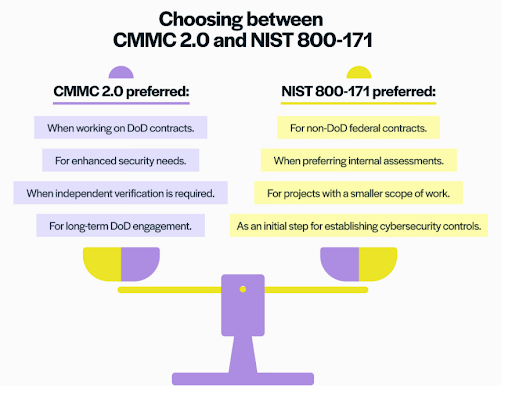
In practice this isn’t an either/or choice — NIST 800-171 implementation is the baseline for almost every DoD contractor handling CUI, and CMMC determines how that baseline gets checked on a given contract. The chart below reflects how contractors typically think about the two in planning conversations.
Key Differences That Actually Matter
| Difference | What It Means in Practice |
|---|---|
| Certification vs. self-attestation | NIST 800-171 alone never required outside verification; CMMC Level 2 typically does. |
| POA&M limits | CMMC restricts Plans of Action & Milestones — high-weight (3- and 5-point) controls can't be deferred. |
| Contract gatekeeping | DFARS 252.204-7021 makes the required CMMC level a condition of contract award, not just a best practice. |
| Assessment cadence | NIST 800-171 compliance is an ongoing posture; CMMC certification has a defined validity period and reassessment cycle. |
| Scope nuance | NIST 800-171 includes Non-Federal Organization (NFO) controls that sit outside CMMC's scored requirements. |

2026 Update: CMMC Phase 2 Suspension — What It Means
Important context: B4Q Assurance works with Defense Industrial Base contractors across the CMMC and NIST 800-171 journey — from initial CUI scoping through System Security Plan (SSP) development and assessment readiness — and this guide reflects the patterns we see across those engagements.
What has not changed: CMMC Phase 1 remains fully active. Contractors must still complete self-assessments where required, submit scores through the Supplier Performance Risk System (SPRS), file annual affirmations, and — critically — continue meeting NIST 800-171 obligations under DFARS 252.204-7012, which was never part of the pause.
Phase 2, which would have made mandatory C3PAO certification a condition of award starting November 10, 2026, is on hold pending a Reform Task Force report expected around mid-September 2026. The DoD’s public request for comment on reforming CMMC remains open through August 14, 2026. Certifications already issued (over 1,300 as of the Cyber AB’s May 2026 town hall) remain valid and are not affected by the suspension.
The practical takeaway for contractors: this is a pause on how compliance gets verified for Level 2 and Level 3, not a pause on the underlying requirement to implement NIST 800-171. Teams that stop NIST 800-171 work because “CMMC got paused” are misreading the announcement.
How the Two Frameworks Work Together, Step by Step
At a high level, most contractors move through the same sequence regardless of which CMMC level ultimately applies:
- Identify where CUI and FCI live in your systems
- Implement the NIST 800-171 controls across that scope
- Determine the CMMC level required by your specific contract or solicitation
- Choose the applicable assessment path — self-assessment, C3PAO audit, or DIBCAC review
- Document a System Security Plan (SSP) and any Plan of Action & Milestones (POA&M)
- Submit your score through the Supplier Performance Risk System (SPRS)
- Complete certification (Level 2/3) or file your annual affirmation (Level 1)
- Maintain continuously — annual affirmations, control monitoring, and reassessment on cycle
Step 1–2: Scope and Implement
Everything downstream depends on an accurate CUI/FCI inventory. Underscoping here is the single most common reason contractors fail an assessment later — systems get missed, especially cloud services, backup pipelines, and subcontractor-managed tools that touch CUI without anyone flagging them.
Step 3–4: Determine the Level and Assessment Path
The CMMC level isn’t a company-wide designation you choose — it’s specified in the contract or solicitation itself. Some contractors juggle multiple levels across different active contracts simultaneously.
Step 5–6: Document and Score
Assessors and C3PAOs weigh documentation as heavily as the controls themselves. An SSP that accurately reflects reality, plus an honest SPRS score, is what turns implementation into a verifiable, contract-ready posture.
Step 7–8: Certify and Maintain
Certification is a snapshot, not a finish line. Annual affirmations and periodic reassessment are what keep that snapshot current between formal audits.
Consequences of Getting This Relationship Wrong
| Consequence | What It Looks Like |
|---|---|
| Lost contract eligibility | Failing to meet the CMMC level specified in a solicitation disqualifies a bid outright |
| Stalled active contracts | Program milestones and payments can pause while assessment gaps are remediated |
| Blocked certification | High-weight controls (3- and 5-point) can't use a POA&M, so major gaps stop conditional certification |
| Strained prime relationships | Subcontractors without the required level become harder for primes to flow work to |
| Wasted spend | Companies that treat CMMC as a separate project from NIST 800-171 often duplicate work unnecessarily |
Why This Relationship Matters for Your Business
Beyond contract eligibility, understanding how CMMC and NIST 800-171 fit together prevents the most expensive mistake in this space: building two separate compliance programs when one, well-documented NIST 800-171 implementation already does most of the work CMMC verifies. Getting the relationship right the first time keeps budget, timeline, and audit readiness aligned instead of duplicated.
Common Mistakes Contractors Make
- Assuming CMMC replaces NIST 800-171 entirely, rather than verifying it
- Treating an SPRS score as a one-time submission instead of a maintained, current figure
- Waiting for a contract to explicitly require CMMC before starting NIST 800-171 work
- Reading the July 2026 Phase 2 suspension as removing all CMMC-related obligations
- Overlooking Non-Federal Organization (NFO) controls in NIST 800-171 that fall outside CMMC’s scored requirements
How B4Q Assurance Helps
B4Q Assurance works with Defense Industrial Base contractors preparing for NIST 800-171 implementation and CMMC 2.0 assessment readiness — scoping the CUI environment, building the System Security Plan, and preparing teams for self-assessment or C3PAO-led review.
Resources
FAQs
Does CMMC 2.0 replace NIST SP 800-171?
No. CMMC uses NIST 800-171 as its technical foundation for Level 2 and adds a formal verification process on top of it. Contractors still must implement all 110 NIST 800-171 controls; CMMC determines how that implementation gets checked.
Do all defense contractors need to be CMMC certified?
Only if the specific contract or solicitation requires it. CMMC is being phased into DoD contracts over time rather than applying universally on a single date, so the requirement depends on what appears in your active and upcoming contracts.
What actually changed with the July 2026 Phase 2 suspension?
Mandatory third-party (C3PAO) assessments for Level 2 and government-led Level 3 assessments were paused pending a Reform Task Force review. NIST 800-171 implementation obligations under DFARS 252.204-7012 were not affected and remain fully in force.
How many controls overlap between the two frameworks?
CMMC Level 2 aligns directly with all 110 NIST SP 800-171 Rev. 2 controls. Level 3 adds a further 24 controls drawn from NIST SP 800-172 for enhanced protection against advanced threats.
Can a POA&M be used to pass a CMMC assessment?
Only partially. A conditional certification is possible at a minimum score of 80%, but higher-weighted requirements (3- and 5-point controls) must be fully implemented and are not eligible for deferral through a POA&M.