
What HIPAA Actually Requires — and What Most Vendors Get Wrong
HIPAA Business Associate Agreement Almost every health-tech company signs one of these within its first year of selling into healthcare — often without reading it closely. A Business Associate Agreement (BAA) is the contract that turns HIPAA from “a law that applies to hospitals” into “a law that applies to you.” Treat it as boilerplate and you inherit real legal exposure without realizing it; understand it properly and it becomes one of the clearest, most defensible parts of your entire compliance program.
This guide covers what a BAA legally must contain, who actually needs one (and the surprisingly common cases where nobody does), how obligations flow down through subcontractors, what happens when a BAA is missing or deficient, and how AI tools and cloud platforms fit into all of this in 2026.
�� Quick Answer – A BAA is a written, signed contract required under 45 CFR 164.504(e) whenever a vendor creates, receives, maintains, or transmits PHI on behalf of a covered entity. It must define permitted uses of PHI, require security safeguards, mandate breach reporting, and flow the same obligations down to any subcontractor. There is no such thing as a verbal or implied BAA, and missing one is one of OCR’s most commonly cited violations.
What Is a Business Associate, Exactly?
A business associate is any person or organization — outside the covered entity’s own workforce — that performs a function or activity involving the use or disclosure of PHI on the covered entity’s behalf. The test isn’t the vendor’s industry or job title; it’s whether PHI actually flows to them as part of the service.
| Likely a Business Associate | Likely NOT a Business Associate |
|---|---|
| Cloud hosting provider storing PHI (AWS, Azure, GCP) | Courier or postal service acting only as a data conduit |
| Billing or claims-processing vendor | Janitorial staff who might incidentally glimpse a screen |
| EHR or patient-engagement SaaS platform | Attorney or accountant with no access to PHI |
| Collaboration tool used to share PHI (e.g., email, chat) | Vendor providing a service where PHI exposure is purely incidental |
| Data analytics or AI vendor processing patient records | A health plan sponsor's own employer (in most structures) |
| Answering service or call center handling patient calls | Two providers jointly treating the same patient (organized health care arrangement) |
How HIPAA Business Associate Agreement Requirements Evolved
The obligations that exist today didn’t arrive all at once. Three legal milestones — spread across nearly three decades — shaped what a compliant BAA has to include.
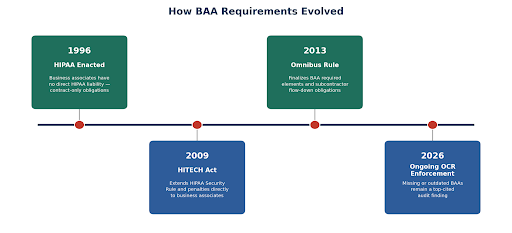
Before 2009, a business associate’s only real exposure was contractual — if something went wrong, the covered entity could sue for breach of contract, but the federal government generally couldn’t penalize the vendor directly. The HITECH Act changed that permanently, and the 2013 Omnibus Rule turned the change into detailed, enforceable text. Every requirement described in the rest of this guide traces back to one of these two milestones.
The 8 Required Elements of a Compliant HIPAA Business Associate Agreement
Regardless of format, length, or which party drafted it, HHS regulations require every BAA to address the same core set of provisions. Missing even one is a common audit finding.
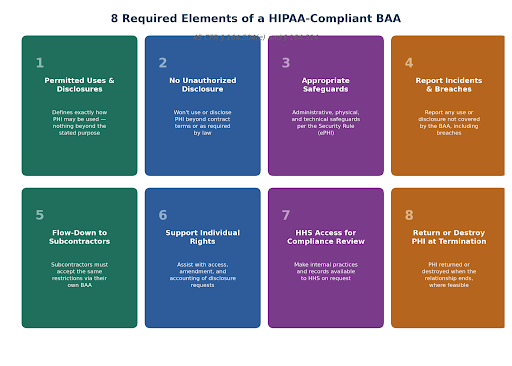
- Permitted uses and disclosures: the agreement must spell out specifically how the business associate is allowed to use PHI — vague or generic language here is the single most common deficiency found in compliance audits.
- No unauthorized use or disclosure: an explicit commitment that PHI won’t be used or shared beyond what the contract allows or what the law separately requires.
- Appropriate safeguards: administrative, physical, and technical safeguards consistent with the Security Rule, which apply directly to the business associate for electronic PHI.
- Breach and incident reporting: the business associate must report any use or disclosure outside the contract terms, including breaches of unsecured PHI, back to the covered entity.
- Subcontractor flow-down: any subcontractor that creates, receives, maintains, or transmits PHI on the business associate’s behalf must sign its own BAA with equivalent terms.
- Support for individual rights: reasonable assistance with patient requests for access, amendment, and an accounting of disclosures.
- HHS access for compliance review: internal practices, books, and records related to PHI must be made available to HHS on request.
- Return or destruction of PHI at termination: when the relationship ends, PHI must be returned or destroyed where feasible — and if not feasible, protections must continue indefinitely.
The HIPAA Business Associate Agreement Chain: Why Subcontractors Can't Skip It
PHI protection doesn’t stop at the first vendor a covered entity contracts with. If that vendor uses its own vendors — a cloud host, an analytics provider, a support subcontractor — the same obligations have to flow down through a separate, equally binding BAA at each link.
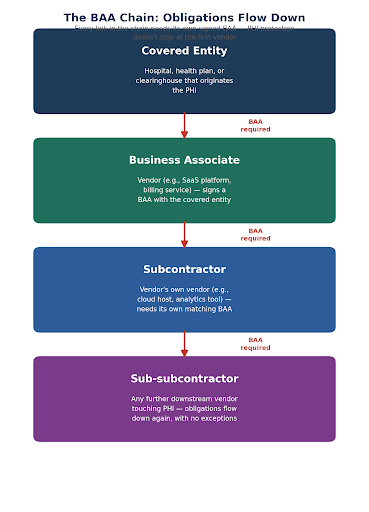
This is where many health-tech companies get caught off guard. A startup might have a clean, well-negotiated BAA with its hospital customer, but if its own cloud provider, customer-support vendor, or embedded analytics tool doesn’t have a matching BAA in place, the entire chain is out of compliance — and OCR has shown it will pursue penalties across multiple parties in the same incident.
�� Common Trap Assuming a major cloud or AI vendor “automatically” covers you with a BAA once you sign up. Verify explicitly: confirm a signed BAA is on file, that it names the specific services you’re actually using, and that it’s been updated since your last change in architecture or vendor. Many enterprise agreements only extend BAA coverage to certain SKUs or configurations.
Cloud Providers, SaaS Tools, and AI: Who Actually Signs a BAA in 2026
Modern health-tech stacks routinely span a dozen or more vendors that could each independently qualify as a business associate. The table below reflects how this typically plays out across common categories.
| Vendor Category | BAA Availability | What to Verify |
|---|---|---|
| Major cloud infrastructure (AWS, Azure, Google Cloud) | Offered, but conditional | Confirm HIPAA-eligible services list; audit logging and encryption must be configured correctly on your side |
| Enterprise collaboration (Microsoft 365, Google Workspace) | Offered on qualifying plans | Confirm the specific plan/tier includes BAA coverage — not all consumer tiers do |
| Public consumer AI tools (general chat interfaces) | Not offered | Do not input PHI into consumer-facing AI tools without an enterprise/API BAA in place |
| Enterprise or API-tier AI platforms | Offered by some providers, product-specific | Confirm in writing whether patient data is used for model training and get that excluded |
| EHR and practice-management platforms | Typically included in standard contract | Confirm the BAA is current and covers every module/integration you use |
| Niche analytics, marketing, or support tools | Often overlooked | Treat any tool that could touch PHI as a business associate until proven otherwise |
How HIPAA Business Associate Agreement Requirements Evolved
The obligations that exist today didn’t arrive all at once. Three legal milestones — spread across nearly three decades — shaped what a compliant BAA has to include.
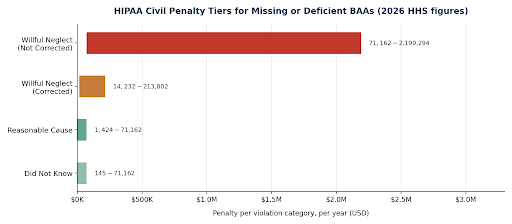
Both covered entities and business associates can be penalized directly and independently for the same missing-BAA finding — one party’s failure doesn’t shield the other. OCR has cited the absence of a BAA specifically in multiple settlements over the years, in several cases as the central or sole finding driving the penalty.
Common HIPAA Business Associate Agreement Drafting Mistakes
- Vague permitted-use language: describing the allowed use of PHI in broad, generic terms instead of tying it to the specific service being provided.
- Treating the BAA as pure boilerplate: signing a template attached to a service agreement without reading or negotiating its terms.
- Missing subcontractor coverage: assuming a vendor’s own downstream tools are “their problem” rather than confirming flow-down BAAs exist.
- Outdated templates: using a BAA drafted before the 2013 Omnibus Rule that never accounts for the current breach definition or subcontractor requirements.
- Unclear breach-reporting ownership: some BAAs quietly shift the covered entity’s notification obligations to the business associate without confirming the vendor can actually execute them.
- No process for verifying AI and cloud sub-processors: adding new tools to a tech stack without checking whether each one independently requires its own BAA.
Optional Clauses Worth Negotiating
Beyond the eight required elements, BAAs often include negotiated clauses that go further than the regulatory floor. These aren’t mandatory, but they show up often enough to be worth watching for on both sides of the table.
- Enhanced security requirements: a covered entity may require safeguards beyond the Security Rule’s baseline, such as mandatory multi-factor authentication.
- State-law preemption clauses: added where a state’s privacy law is stricter than HIPAA and legally overrides it for that relationship.
- Liability and cost-shifting language: provisions making the business associate responsible for breach-response costs if the incident traces to its own negligence or willful misconduct.
- Audit-report sharing: a clause requiring the business associate to share its own independent compliance report (e.g., a HITRUST or SOC 2 report) on request.
- Narrowed access-request carve-outs: some vendor-drafted BAAs exclude responsibility for patient access/amendment requests where the vendor doesn’t maintain a designated record set — reasonable, but worth confirming applies to your architecture.
Competitor Content Analysis
A look at what’s currently ranking for “hipaa business associate agreement” and adjacent terms shows a fairly split field between legal publishers, compliance-automation vendors, and government sources.
- HHS.gov is the authoritative baseline: the official sample BAA provisions and business-associate FAQ pages rank consistently and are cited by nearly every competing article, but they’re written in dense regulatory language with no visual aids or plain-language framing.
- Compliance-automation platforms lead with product framing: sites like Medcurity and similar platforms front-load the regulatory explanation but pivot quickly into their own BAA-tracking or automation tooling, which can undercut trust for a reader who just wants the legal answer.
- Law-firm content is the most rigorous but least accessible: publishers like Holland & Knight and Holland & Hart go deep on drafting nuance and negotiation risk, which is valuable but dense — there’s an opening for the same substance in a more scannable format.
- AI-tool coverage is thin and inconsistent: very few competing pages address how public AI tools like consumer chat interfaces interact with BAA obligations in detail, despite it being an increasingly common practical question in 2026.
- Almost nobody visualizes the subcontractor chain: the flow-down obligation is explained in every competing article but shown visually in almost none of them — a genuine differentiation opportunity.
- Penalty figures vary by publish date: several older articles still cite pre-2026 HHS penalty figures; citing the current inflation-adjusted tiers with a date is a small but meaningful accuracy edge.
Search Intent: What People Are Actually Asking
Short notes on the intent behind this topic and its related searches, based on how the query is typically phrased:
- Primary intent is transactional-legal: most searchers have a BAA in front of them right now — from a vendor, a customer, or their own legal team — and want to know if it’s actually compliant, not just what a BAA is in the abstract.
- “Do I need a BAA with X” is a huge related-query cluster: searches frequently name a specific vendor category (cloud host, email provider, AI tool, contractor) rather than asking generically, which signals real, in-progress vendor evaluations.
- AI-specific queries are rising sharply: “chatgpt hipaa baa,” “is gemini hipaa compliant,” and similar searches point to a fast-growing intent cluster around whether AI tools can be used with patient data at all.
- Penalty and enforcement searches trail closely behind: “hipaa baa penalty,” “ocr settlement missing baa,” and similar queries suggest a meaningful share of searchers are assessing risk after the fact, not just planning ahead.
- Template-seeking behavior is common but secondary: some searchers want a sample agreement to start from — worth linking directly to the HHS sample provisions rather than trying to replace them.
HIPAA Business Associate Agreement AI Overview
If this topic were condensed into an AI-generated search summary, it would likely read: A Business Associate Agreement (BAA) is a legally required, signed contract between a HIPAA covered entity and any vendor that creates, receives, maintains, or transmits protected health information on its behalf. Required since the HITECH Act of 2009 and formalized by the 2013 Omnibus Rule, a compliant BAA must define permitted uses of PHI, require appropriate safeguards, mandate breach reporting, and extend the same obligations to any subcontractor down the chain. There is no BAA exemption for cloud providers, AI tools, or SaaS platforms that touch PHI — coverage must be confirmed vendor by vendor, and gaps anywhere in the subcontractor chain can expose every party above it to direct HIPAA penalties, which in 2026 range from roughly $145 to over $2.19 million per violation category depending on culpability.
�� Worth Remembering – An AI overview or quick search answer on this topic will tell a reader that a BAA is required — but it won’t tell them whether the specific BAA sitting in their inbox actually meets all eight required elements, or whether their own subcontractors have one. That verification step is where most real-world gaps live.
A Practical HIPAA Business Associate Agreement Checklist
- Maintain a live inventory of every vendor that could plausibly touch PHI — not just the obvious ones.
- Confirm a signed BAA exists for each vendor before any PHI flows to them, not after.
- Check that each BAA names the specific services/products in use, not a generic “all services” clause that may not match reality.
- Re-verify BAA coverage whenever you add a new integration, module, or AI feature to an existing vendor relationship.
- Track subcontractor BAAs separately — your vendor’s own vendors are your exposure too.
- Revisit older BAAs (especially pre-2013 templates) for outdated breach definitions or missing subcontractor language.
- Include BAA status as a standing item in vendor risk reviews, not a one-time onboarding checkbox.
How B4Q Assurance Helps
B4Q Assurance helps digital health companies inventory every vendor and subcontractor that touches PHI, verify that each BAA actually contains all eight required elements, and build an ongoing tracking process so BAA coverage doesn’t quietly go stale as your vendor stack changes.
HIPAA Business Associate Agreement Related Resources
- HHS — Sample Business Associate Agreement Provisions — https://www.hhs.gov/hipaa/for-professionals/covered-entities/sample-business-associate-agreement-provisions/index.html
- HHS — Business Associates FAQ — https://www.hhs.gov/hipaa/for-professionals/faq/business-associates/index.html
- HHS — Model Business Associate Agreement (PDF) — https://www.hhs.gov/sites/default/files/model-business-associate-agreement.pdf
- HHS — HIPAA Security Rule Guidance — https://www.hhs.gov/hipaa/for-professionals/security/index.html
FAQs
Do we need a BAA with every vendor we use?
Only with vendors that create, receive, maintain, or transmit PHI on your behalf, or where PHI exposure is more than incidental. A vendor with no meaningful access to PHI — a courier, an accountant with no PHI visibility — generally doesn’t need one.
Can a BAA be verbal or implied?
No. HIPAA requires a written, signed contract. Verbal assurances or an informal understanding don’t satisfy the requirement, regardless of intent.
What if our vendor refuses to sign a BAA?
You cannot legally share PHI with that vendor until a compliant BAA is in place. Proceeding without one exposes both parties to direct HIPAA liability.
Does a signed BAA make a vendor fully HIPAA compliant?
No. The BAA sets contractual and legal obligations; the vendor still has to actually implement the required safeguards, training, and processes. A signed BAA without operational follow-through is a paper commitment, not compliance.
Do AI tools require a BAA before we can use them with patient data?
Yes, if PHI will be part of any input. Public, consumer-facing AI tools generally do not offer BAAs; enterprise or API-tier offerings from some providers do, but availability is product-specific and must be confirmed and reviewed before any PHI is entered.