
HIPAA Compliance Checklist for Digital Health Startups
Hipaa compliance checklist isn’t a certificate you earn once and file away — it’s an ongoing set of documented controls that protect Protected Health Information (PHI), and it applies the moment your startup creates, receives, maintains, or transmits PHI, even briefly. There’s no government body that audits you and hands you a HIPAA seal; what you actually need is evidence — a risk assessment, signed agreements, working safeguards, and a trained team — that holds up if a regulator or an enterprise customer asks to see it. This checklist walks through exactly what that evidence looks like for a digital health startup.
Quick idea
HIPAA applies once you create, receive, maintain, or transmit PHI as a covered entity or a business associate — company size doesn’t exempt you.
No certification: OCR doesn’t issue HIPAA certificates. Compliance is evidence-based: documented risk assessments, safeguards, and agreements that hold up under scrutiny.
Three rules: The Privacy Rule, Security Rule, and Breach Notification Rule together define what you must do, how you must protect ePHI, and what happens if something goes wrong.
Context: B4Q Assurance works with digital health startups to scope PHI exposure, build right-sized safeguards, and prepare evidence that satisfies both OCR and enterprise due diligence.
Business Associate Agreements
Every vendor that touches PHI on your behalf needs a signed Business Associate Agreement (BAA) before that PHI ever reaches them — not after. A BAA obligates the vendor to protect PHI to HIPAA’s standards and to notify you if something goes wrong on their end. Cloud infrastructure providers, analytics tools, customer support platforms, email providers, and AI or ML vendors all need a BAA if PHI passes through them in any form. A common and costly mistake: adopting a consumer-grade tool — a personal Gmail account, free-tier Slack, or a non-BAA AI API — because it’s convenient, without confirming a BAA is available first. These tools are HIPAA violations waiting to happen, not compliance shortcuts.
The Three Rules That Make Up Hipaa compliance checklist
Hipaa compliance checklist rests on three interlocking rules. Miss one and the other two don’t hold up.
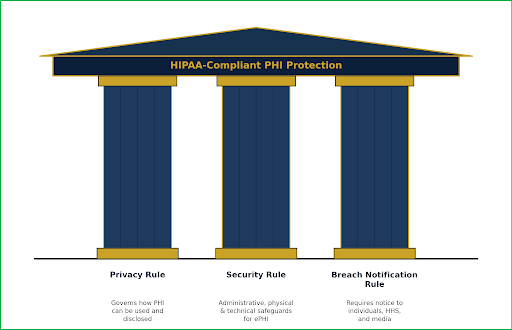
- Privacy Rule — governs how PHI can be used and disclosed, including the “minimum necessary” standard: only access or share the PHI actually needed for the task at hand.
- Security Rule — requires administrative, physical, and technical safeguards specifically for electronic PHI (ePHI), and is the rule most directly shaped by your product architecture.
- Breach Notification Rule — sets out exactly who you must notify, and how fast, if PHI is exposed without authorization.
Administrative, Physical, and Technical Safeguards
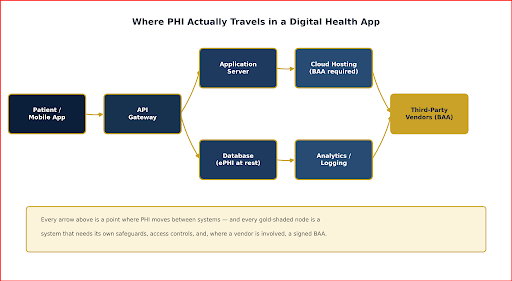
The Security Rule organizes its requirements into three safeguard categories. The underlying goal is the same in each — protect ePHI — but the mechanism differs.
| Safeguard Category | What It Covers | Examples for a Digital Health Startup |
|---|---|---|
| Administrative | Policies, workforce training, risk management, and designated ownership | Named Privacy & Security Officers, annual risk assessments, role-based training, incident response plans |
| Physical | Controlling physical access to systems and devices that store or access ePHI | Restricted server room access, device inventory and disposal procedures, screen-lock policies |
| Technical | Technology controls that protect ePHI in your systems and networks | Encryption at rest and in transit, MFA, access logging, automatic session timeouts, audit trails |
Quick idea
Hipaa compliance checklist applies once you create, receive, maintain, or transmit PHI as a covered entity or a business associate — company size doesn’t exempt you.
No certification: OCR doesn’t issue HIPAA certificates. Compliance is evidence-based: documented risk assessments, safeguards, and agreements that hold up under scrutiny.
Three rules: The Privacy Rule, Security Rule, and Breach Notification Rule together define what you must do, how you must protect ePHI, and what happens if something goes wrong.
Context: B4Q Assurance works with digital health startups to scope PHI exposure, build right-sized safeguards, and prepare evidence that satisfies both OCR and enterprise due diligence.
Business Associate Agreements
If PHI is exposed without authorization, the notification clock starts the moment you discover it — not the moment you finish investigating it.
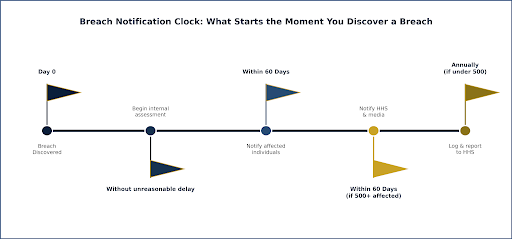
Notification obligations scale with how many individuals are affected. Breaches affecting 500 or more individuals require notifying HHS and, in most cases, the media, within 60 days — the same window as individual notification. Breaches affecting fewer than 500 individuals can be logged and reported to HHS annually rather than immediately, but individual notification is still due within 60 days regardless of breach size.
What Happens If You Don't Comply
HIPAA penalties are tiered by the organization’s level of culpability, not simply by whether a breach occurred. The figures below reflect the 2026 inflation-adjusted amounts published by HHS.
| Tier | Culpability | Penalty Range (per violation) |
|---|---|---|
| Tier 1 | Did not know, and could not reasonably have known, about the violation | $141 – $73,011; annual cap ~$36,505 under current enforcement discretion |
| Tier 2 | Reasonable cause, not willful neglect | $1,452 – $73,011; annual cap ~$146,053 |
| Tier 3 | Willful neglect, corrected within 30 days | $14,522 – $73,011; annual cap ~$365,052 |
| Tier 4 | Willful neglect, not corrected within 30 days | $73,011 – $2,190,294 per violation; annual cap $2,190,294 |
OCR typically reserves enforcement action for cases involving an actual breach or a clear pattern of non-compliance, and organizations that can demonstrate a current risk assessment, enforced policies, and prompt breach response are far more likely to receive a corrective action plan than a maximum penalty. But missing a BAA, skipping a risk assessment, or having no workforce training are all violations on their own — a breach is usually just what draws OCR’s attention to them.
A Practical Compliance Roadmap for Startups
Retrofitting HIPAA compliance after launch is far more expensive than building it in from the start. For a focused, early-stage product, here’s a realistic sequence.
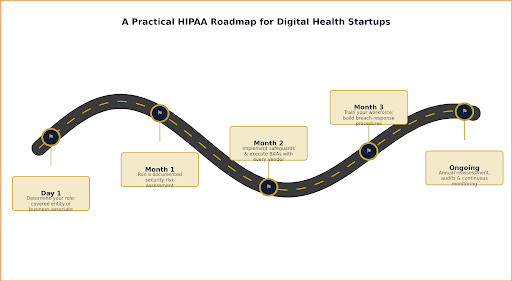
- Day 1 — Determine your role. Are you a covered entity, a business associate, or potentially both? This decision shapes every requirement that follows.
- Month 1 — Run a documented risk assessment. Inventory every system, API, and vendor that touches PHI, and rate the risks you find. This doesn’t need to be a hundred pages — it needs to exist and be accurate.
- Month 2 — Implement priority safeguards and execute BAAs with every vendor in your PHI data flow before PHI reaches them, not after.
- Month 3 — Train your workforce on Privacy and Security Rule basics, and build a tested breach response and notification procedure.
- Ongoing — Reassess annually, and whenever you launch a major feature, add a vendor, or experience an incident. HIPAA compliance doesn’t stop after the first pass.
Common Mistakes Digital Health Startups Make
- Treating compliance as a launch blocker instead of a design decision — retrofitting encryption, logging, and access controls later is far more expensive than building them in.
- Using free-tier or consumer-grade cloud services that don’t offer a BAA, then discovering the gap only when an enterprise customer asks for proof.
- Logging too little detail — “someone accessed a record” isn’t sufficient; audit logs need timestamps, user IDs, IP addresses, and exactly what was accessed.
- Skipping the documented risk assessment entirely, or treating an old one as still valid after a major product or infrastructure change.
- Assuming a developer or engineering team already understands HIPAA’s specific requirements — it’s a specialized area, and assumptions here are a common source of gaps.
Why Getting This Right Matters Beyond Avoiding Fines
A demonstrable Hipaa compliance checklist posture does more than reduce regulatory exposure — it’s frequently the deciding factor in enterprise sales cycles. Covered entities will not sign with a vendor that can’t produce a current risk assessment, working safeguards, and a signed BAA, and increasingly expect a SOC 2 Type II report alongside it. Startups that build compliance in early close enterprise deals faster and avoid the far more expensive retrofit later.
How B4Q Assurance Helps
B4Q Assurance works with digital health startups to determine covered entity or business associate status, run documented Security Rule risk assessments, implement right-sized administrative, physical, and technical safeguards, and prepare Business Associate Agreements and breach response procedures that hold up under both OCR scrutiny and enterprise due diligence.
Resources
FAQs
Is there a HIPAA certification we can get to prove compliance?
No. OCR does not issue HIPAA certificates, and no government body audits organizations to confirm compliance. What you can produce is evidence — a current risk assessment, documented safeguards, signed BAAs, and training records — that demonstrates compliance if OCR investigates or a customer asks.
Are we a business associate if we only touch PHI briefly?
Yes. HIPAA applies if you create, receive, maintain, or transmit PHI on behalf of a covered entity, even briefly. Duration doesn’t determine applicability — the fact that PHI passed through your systems does.
Do we need a BAA with every cloud provider we use?
Only with providers that could touch PHI. But that list is often wider than teams expect — it includes hosting, analytics, logging, customer support, and email tools if PHI could reasonably pass through them, not just your primary database.
What's the fastest way to get enterprise-ready for a healthcare customer?
Start with a documented risk assessment and BAAs for every vendor touching PHI — these are usually the first things a covered entity’s procurement team asks for. A SOC 2 Type II report alongside your HIPAA program strengthens the picture further for most enterprise health-tech buyers.
Does breach size change our notification deadline?
Individual notification is due within 60 days of discovery regardless of size. What changes with size is who else you must notify: breaches affecting 500 or more individuals require notifying HHS and the media within the same 60-day window, while smaller breaches can be reported to HHS annually.