
HIPAA vs SOC 2: Do You Need Both for Your Health-Tech Product?
HIPAA vs SOC 2 Health-tech founders usually hit this question the moment a prospective enterprise customer’s security team sends over a vendor questionnaire: “Are you HIPAA compliant? Do you have a SOC 2 report?” The two get treated as interchangeable proof of security maturity, but they answer different questions, come from different rulebooks, and, in most cases, a growing digital health company ends up needing both — just not for the same reason.
This article breaks down what each framework actually verifies, where they overlap, and how to figure out which one, or both, your product needs right now.
Quick idea
HIPAA is a legal requirement — it applies automatically the moment you touch PHI, with no opt-out.
SOC 2 is a voluntary trust report — nobody forces you to get one, but enterprise buyers increasingly won’t sign without it.
Different questions: HIPAA asks whether patient health data is protected under federal law; SOC 2 asks whether a vendor can be trusted to run secure, reliable systems generally.
Context: B4Q Assurance helps health-tech companies map which framework applies to which part of their product, and builds one combined evidence program instead of two disconnected ones.
Two Different Questions HIPAA vs SOC 2, Two Different Frameworks
HIPAA vs SOC 2 come from entirely different places — one is federal law, the other is a market-driven audit standard — and knowing the distinction is the first step in scoping either one correctly.
| HIPAA | SOC 2 | |
|---|---|---|
| What it is | A U.S. federal law under HHS regulation | An auditing standard maintained by the AICPA |
| Is it mandatory? | Yes, if you touch PHI — no exceptions for size or stage | No — a market expectation, not a legal duty |
| Who "grants" it | Nobody; you self-attest and hold evidence | An independent, licensed CPA firm issues a report |
| What you get | No certificate — documented compliance | A formal SOC 2 Type I or Type II report |
| Who typically asks | Regulators (OCR), covered-entity customers | Enterprise procurement and security teams |
| Scope of concern | Protected Health Information (PHI) specifically | Any customer data, across five trust categories |
What SOC 2 Actually Measures
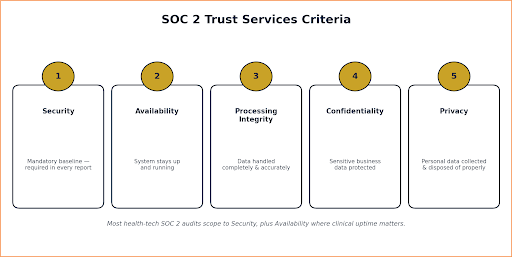
SOC 2 reports are built around five Trust Services Criteria. You don’t need to satisfy all five — most health-tech companies scope their audit to Security, plus one or two others relevant to their product.
Where the Two HIPAA vs SOC 2 Frameworks Overlap
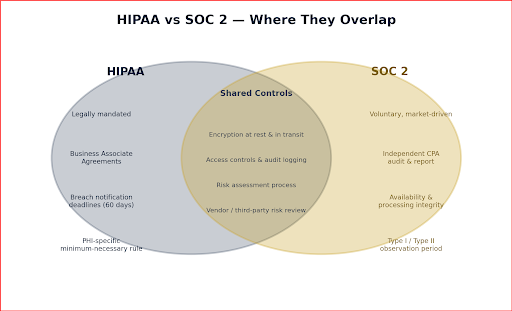
The diagram below maps which controls are HIPAA-specific, which are SOC 2-specific, and which single set of controls satisfies both.
| Area | HIPAA | SOC 2 |
|---|---|---|
| Encryption at rest / in transit | Yes (Security Rule) | Yes (Security criterion) — genuine overlap |
| Access controls & audit logging | Yes | Yes, though HIPAA requires PHI-specific detail SOC 2 doesn't mandate |
| Breach notification deadlines | Yes — legally mandated (60 days) | No formal deadline; expects a documented process only |
| Business Associate Agreements | Yes — required with every vendor touching PHI | No equivalent concept |
| Independent third-party audit | No — self-attested | Yes — mandatory CPA audit |
| Vendor / third-party risk review | Indirectly, via BAAs | Yes, explicitly assessed |
| Uptime / system reliability | Not addressed | Yes, under the Availability criterion |
Which Framework(s) Does Your Company Actually Need?
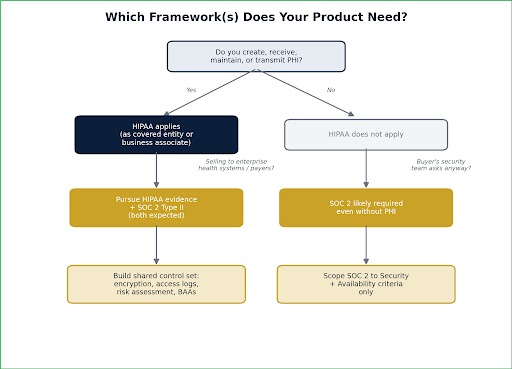
Use the decision flow below to see how the answer depends less on your product and more on who you sell to.
| Your Situation | HIPAA | SOC 2 |
|---|---|---|
| Handles PHI, sells only to hospitals/clinics | Required | Optional, increasingly requested |
| Handles PHI and sells into enterprise health systems / payers | Required | Expected — often a procurement blocker without it |
| B2B SaaS tool touching PHI only incidentally | Required as a business associate | Often required by customers regardless of PHI volume |
| No PHI at all, but sells software to healthcare companies | Not applicable | Frequently required anyway |
Building Both Without Duplicating the Work
Because Security-criterion SOC 2 controls and HIPAA Security Rule safeguards overlap substantially, the efficient path is one shared build sequence rather than two separate programs run in parallel.
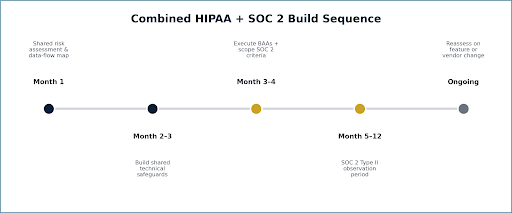
- Start with a shared risk assessment — map data flows once, tagging each system as PHI-scoped, SOC 2-scoped, or both.
- Build technical safeguards to the stricter standard — HIPAA-grade encryption, MFA, and logging generally exceed SOC 2’s baseline.
- Keep HIPAA-specific paperwork separate — BAAs, breach notification procedures, and training records have no SOC 2 equivalent.
- Sequence the audit after the controls are live — SOC 2 Type II needs 3–12 months of evidence that controls actually operated.
- Reassess when the product changes — a new feature or vertical can shift which framework(s) apply.
Common Mistakes Health-Tech Companies Make
- Assuming a SOC 2 report substitutes for HIPAA — it doesn’t cover BAAs, breach deadlines, or PHI-specific access rules.
- Pursuing SOC 2 Type II before HIPAA controls are stable, forcing a restart of the observation period once gaps surface.
- Scoping a SOC 2 audit too broadly (all five criteria) when the sales motion only needs Security and Availability.
- Treating “we’re getting SOC 2’d” as an answer to a hospital’s due-diligence request, when the covered entity specifically needs a signed BAA and HIPAA risk assessment.
Why This Combination Matters Commercially
For most digital health startups, the real driver isn’t which framework is “better” — it’s that the buyer determines the requirement. Sell into hospitals and payers, and HIPAA evidence is non-negotiable. Sell into enterprise IT and security teams, and a SOC 2 report is frequently the gate before anyone reviews the product. Companies that build both into their roadmap early close both types of deals without a scramble mid-negotiation.
How B4Q Assurance Helps
B4Q Assurance helps digital health companies map exactly where HIPAA and SOC 2 requirements overlap and where they diverge, builds a single shared control set that satisfies both, and sequences readiness assessments and audits so founders aren’t running two disconnected compliance projects at once.
Resources
- AICPA — SOC 2 Trust Services Criteria
- HHS — HIPAA Security Rule Guidance
- AICPA — SOC for Service Organizations Overview
FAQs
If we're already HIPAA compliant, do we still need SOC 2?
Often yes. HIPAA compliance proves you handle PHI lawfully; it says nothing about system reliability, processing integrity, or your standing with an independent auditor — all things enterprise security teams specifically ask a SOC 2 report to answer.
If we have a SOC 2 report, does that satisfy HIPAA requirements?
No. SOC 2 has no equivalent to a Business Associate Agreement, no legally mandated breach notification timeline, and no PHI-specific minimum-necessary access standard, all of which HIPAA requires regardless of your SOC 2 status.
Which one should an early-stage startup pursue first?
HIPAA compliance first, if you touch PHI at all — it’s a legal requirement, not a competitive advantage. SOC 2 typically follows once you’re selling into enterprise accounts that ask for it in procurement.
Type I or Type II SOC 2 for a health-tech company?
Type I confirms controls are designed correctly at a point in time; Type II confirms they operated effectively over a period, usually 3–12 months. Most enterprise health-tech buyers specifically want Type II.
Can one compliance program cover both frameworks?
Largely yes for technical and administrative safeguards, since HIPAA’s Security Rule and SOC 2’s Security criterion overlap heavily. HIPAA-specific artifacts — BAAs, breach notification procedures, training records — still need to be maintained separately.