ISO 42001 Certification: Who Needs It and Why (2026 Guide)
ISO 42001 Certification : AI has quietly become part of how most companies operate, whether that’s a customer support bot, a resume screener, a fraud model, or a chatbot embedded in a product. What hasn’t kept pace is proof — some structured, auditable way to show a customer, a regulator, or your own board that the AI is actually being governed and not just deployed and hoped for the best. That’s the gap ISO 42001 was built to close. Published in December 2023, it’s the world’s first certifiable standard for an AI Management System (AIMS), and in 2026 it’s moved from “nice to have on a slide” to something enterprise procurement teams and regulators are actively asking about.
This guide goes deeper than the usual one-page overview. It walks through what an AIMS actually contains, exactly who falls inside the certification’s scope (spoiler: it’s not only companies that sell AI products), what the audit process looks like stage by stage, realistic 2026 timelines and costs pulled from multiple sources rather than one vendor’s best-case pitch, and the mistakes that most commonly derail a first attempt. By the end you should be able to answer the only question that actually matters for planning purposes: does our organization need this now, later, or not at all.
Quick idea:
ISO/IEC 42001:2023 is the international standard for an Artificial Intelligence Management System (AIMS) — a structured way to govern how your organization develops, provides, or uses AI. Certification is voluntary, but a growing number of enterprise buyers, procurement teams, and regulators now treat it as the AI equivalent of a SOC 2 report or an ISO 27001 certificate.
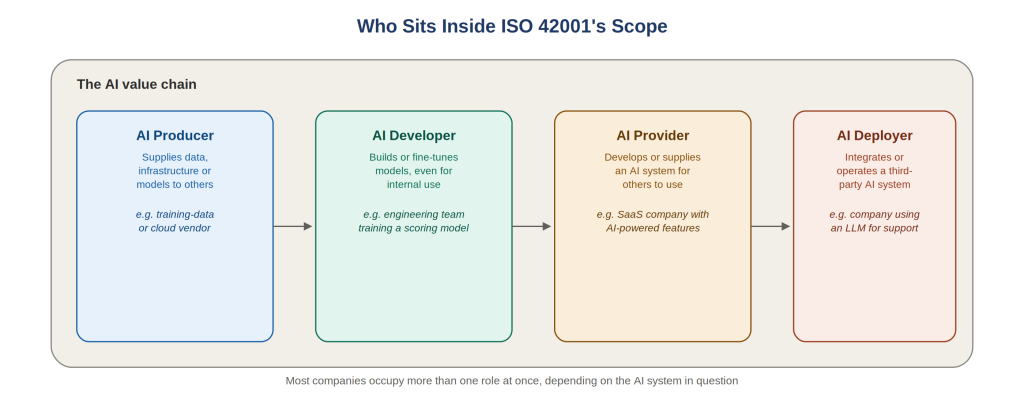
- Not just for AI companies: if your teams build, fine-tune, procure, or even routinely use AI tools, you’re in scope — not only companies that sell AI products.
- Built on a familiar structure: it follows the same Annex SL “harmonized” clause format (4–10) as ISO 27001 and ISO 9001, so existing ISMS work can usually be reused.
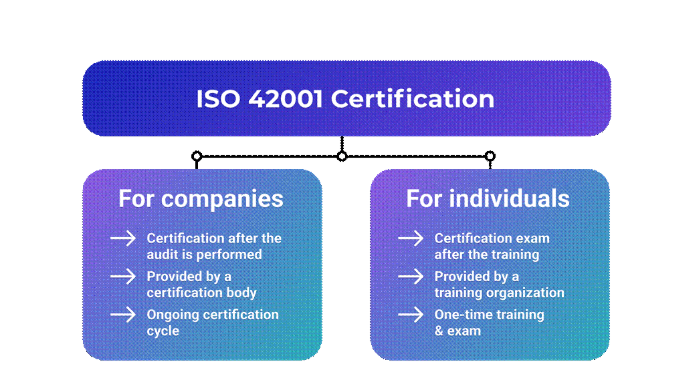
- Two certification tracks exist: organizations get certified through an accredited certification body after an audit; individuals can separately earn a personal ISO 42001 credential through training and an exam — the two are not interchangeable.
- Regulation-adjacent, not regulation itself: ISO 42001 is expected to become a recognized route to demonstrating conformity with parts of the EU AI Act once formal harmonization under Article 40 is complete — it isn’t there yet, but the direction is clear.
Important context:
B4Q Assurance works with AI/ML product companies and SaaS businesses building out AI governance programs — from initial readiness and gap assessments through ISO 42001 certification, whether that’s layered on an existing ISO 27001 or ISO 27701 program or built as a standalone AIMS.
What Is ISO 42001 Certification, Really?
Strip away the acronym and ISO 42001 is asking a fairly practical question: when your organization builds or uses an AI system, does anyone actually own the risk that comes with it? Who signed off on the training data, who’s watching for model drift, who gets called if the system produces a biased or harmful output, and can you prove any of that happened rather than just claim it did? The standard formalizes the answer into an AI Management System (AIMS) — a structured set of policies, roles, risk assessments, and controls covering the AI lifecycle from design through decommissioning.
An AIMS isn’t a single document sitting in a shared drive. It’s the combination of a documented AI policy, defined roles and accountability (who owns AI risk at the leadership level, who operates controls day to day), a risk assessment methodology specific to AI systems (covering things like bias, data quality, robustness, and unintended use), and an ongoing cycle of internal audits and management reviews that keep the system current as your AI use cases evolve. The point isn’t to freeze your AI program in place — it’s to make sure governance keeps pace as the technology and your usage of it change.
ISO doesn’t certify organizations itself — ISO writes and publishes the standard, but certification is carried out by independent, accredited certification bodies (examples include Schellman, BSI, DNV, and A-LIGN) that audit your AIMS against the standard’s requirements and issue a certificate valid for three years, with annual surveillance audits in between to keep it active. It’s worth being precise about this distinction because the standard also supports a completely separate, individual-level credential: professionals can complete training and sit an exam to earn a personal ISO 42001 qualification. That’s useful for building internal expertise, but it is not the same thing as an organizational certificate, and having certified staff does not substitute for certifying the AIMS itself.
How It Fits Alongside Other Frameworks
ISO 42001 was deliberately designed to sit alongside, not replace, the compliance work most companies already do. If you’ve been through ISO 27001 or SOC 2, a lot of the underlying machinery — risk registers, internal audit cadence, document control, management review — is directly reusable.
| Standard | What It Covers | Relationship to ISO 42001 |
|---|---|---|
| ISO 27001 | Information security broadly — all data, all assets | Shares the same clause structure (4–10); existing ISMS controls and audit processes can largely be reused |
| ISO 27701 | Personal data / privacy management | Complements ISO 42001 where AI systems process personal data |
| ISO 9001 | Quality management systems | Same harmonized structure; useful where AI outputs feed into a broader quality process |
| NIST AI RMF | US voluntary AI risk management guidance | Conceptually similar but not certifiable — ISO 42001 is the auditable, certifiable counterpart |
| EU AI Act | Legal obligations for AI providers and deployers in the EU | Expected to become a recognized route to a presumption of conformity once Article 40 harmonization is finalized |
Common Triggers That Push Companies Toward Certification
ISO 42001 rarely gets adopted because a company wakes up one day and decides AI governance sounds nice. It’s almost always a response to a specific pressure. The most common ones we see:
- Enterprise procurement pressure: customers or security questionnaires now asking specifically about AI governance, not just SOC 2 or ISO 27001 — a gap here can stall or lose a deal late in the sales cycle.
- AI becoming core to the product: features moving from an experiment to a revenue-generating part of the product, which raises the stakes of an unmanaged failure.
- “Shadow AI” spreading internally: teams using AI for content generation, data analysis, or customer responses without any company-wide policy governing what’s appropriate.
- Regulatory anticipation: preparing for EU AI Act obligations or operating in a jurisdiction with emerging AI-specific regulation before it becomes mandatory.
- Board or investor pressure: a need to show AI risk is being actively managed rather than assumed away, particularly ahead of a funding round or acquisition.
- Industry-specific exposure: operating in a regulated sector (finance, health-tech, public sector vendors) where AI decisions already carry legal or ethical scrutiny.
What Certification Actually Involves
ISO 42001 follows the same harmonized clause structure (Clauses 4–10) used by ISO 27001 and ISO 9001 — context of the organization, leadership, planning, support, operation, performance evaluation, and improvement — which is part of why organizations with an existing ISMS tend to move faster. Where it diverges is in the detail: Clauses 6 and 8 are expanded specifically to address how the AI system interacts with individuals and the public, and Annex A adds a dedicated set of controls covering the AI lifecycle, data quality, transparency, and third-party AI components.
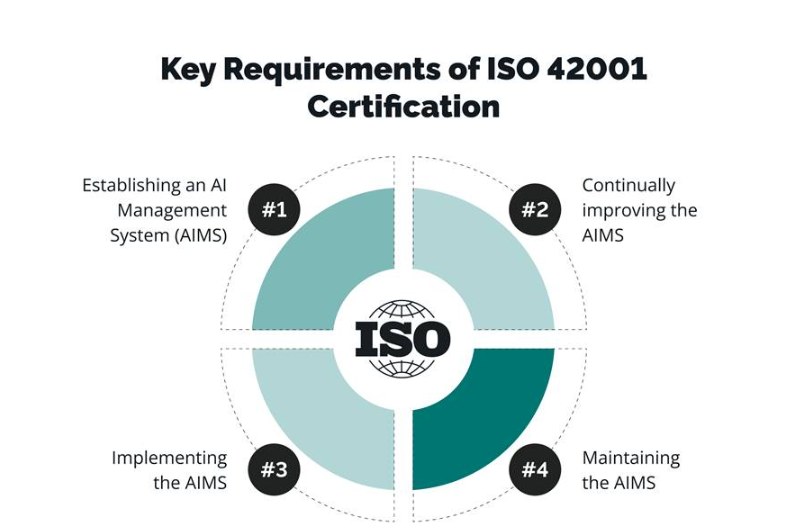
In practice, building the AIMS comes down to four ongoing commitments rather than a one-time project: establishing the system (defining scope, policies, and roles), implementing it (rolling controls out into how teams actually build and use AI), maintaining it (keeping evidence current as systems change), and continually improving it (using audit findings and incidents to make the next cycle better). None of these stop once the certificate is issued — they’re what the annual surveillance audits are checking for.
The audit itself is a two-stage process run by an accredited certification body. Stage 1 reviews whether your documentation and AIMS design are ready for assessment — essentially a readiness check before the real test. Stage 2 tests whether the system is actually operating the way it’s documented, with evidence rather than policy statements: auditors will ask to see logs, sign-offs, risk assessments, and records of internal audits, not just read your policy PDF. Certificates are valid for three years, with annual surveillance audits required in years one and two, and a recertification audit before the three-year mark to renew.
Typical Timeline and Cost (2026)
Cost and timeline estimates vary more than almost any other part of this process, largely because “cost” gets defined differently across sources — certification body fees alone versus total cost including consulting and internal staff time. The honest range, pulled from multiple current sources rather than a single vendor’s pitch:
| Starting Point | Typical Timeline | Typical Total Cost |
|---|---|---|
| Starting from scratch | 4–12 months | Roughly $15,000–$150,000+, depending on org size and scope |
| Existing ISO 27001 ISMS in place | 3–6 months | Generally lower — much of the risk and audit process is reused |
| Mature AI governance program already running | 3–4 months | Cost weighted toward the certification audit rather than implementation |
Breaking that down further: a standalone gap analysis or readiness review typically runs $5,000–$20,000 depending on scope. Guided implementation support for a mid-sized organization commonly lands between $15,000 and $40,000. The certification audit itself — the Stage 1 and Stage 2 combined — is usually priced per audit day by the certification body, with small organizations paying roughly $5,000–$15,000 for the combined audit and larger, more complex scopes running $25,000–$50,000 or more. On top of the external fees, budget real internal time: a small organization should expect to spend somewhere around 25–40 person-days across the AI owner, engineering, legal, and security functions; a large organization can need 80–150 person-days spread across a longer project.
The single biggest cost and timeline lever, consistently across sources, is whether ISO 27001 is already in place. Companies with a mature ISMS can often reuse their risk methodology, internal audit program, and document control system almost directly, which is why the same certification that takes a greenfield company nine to fourteen months can take an ISO 27001-certified company as little as three to four.
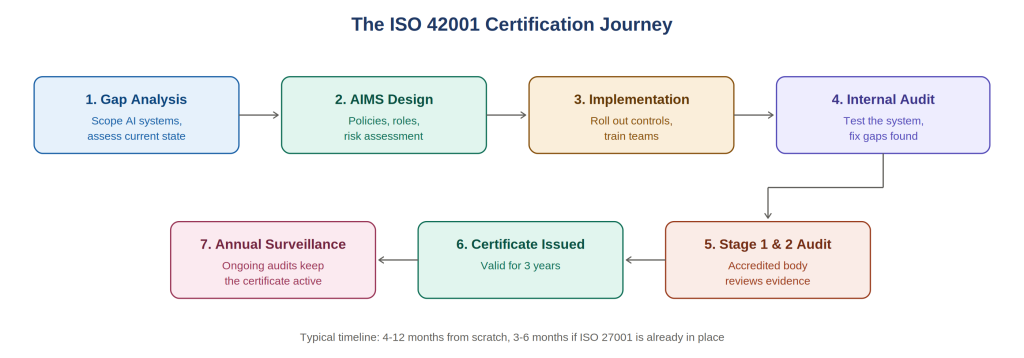
It also doesn’t stop at the certificate. The three-year cycle carries recurring costs that first-time budgets often miss: annual surveillance audits (smaller in scope than the initial certification but still billed by the certification body), ongoing evidence collection as your AI systems evolve, and a full recertification audit before the three-year mark. Treating the certificate as a one-time purchase rather than a standing program is one of the most common planning mistakes organizations make.
What Happens If AI Governance Stays an Afterthought
Most of the cost of skipping AI governance doesn’t show up as a line item — it shows up as friction, later, when it’s harder and more expensive to fix.
| Consequence | What It Looks Like |
|---|---|
| Lost enterprise deals | Procurement teams increasingly ask for ISO 42001 or an equivalent alongside SOC 2 or ISO 27001, and "we don't have that yet" can stall a deal |
| Untracked AI risk | Without a named owner, model drift, biased outputs, or data-quality issues often surface only after a customer or regulator flags them |
| Regulatory exposure | As AI-specific rules mature, documented governance becomes the difference between a manageable finding and a serious one |
| Duplicated effort | Teams that treat AI governance as separate from existing security and privacy work often end up rebuilding the same risk registers twice |
| Slower incident response | Without clear ownership, a flagged AI output or model failure takes longer to route to the right person and resolve |
Preparing for ISO 42001 Certification : A Practical Starting Checklist
Before engaging a certification body or a consultant, most of the groundwork that determines how smoothly certification goes can be done internally. A useful starting checklist:
Inventory every AI system in use across the organization, including tools individual teams have adopted informally, not just company-sanctioned ones
- Decide the certification scope — which business units, products, and AI systems will actually sit inside the audit boundary
- Name an accountable owner for AI governance at a level senior enough to make cross-functional decisions stick
- Check what already exists — an ISO 27001 or ISO 27701 program, existing risk registers, or internal audit processes that can be extended rather than rebuilt
- Run a gap analysis against ISO 42001’s Clauses 4–10 and Annex A controls before writing a single new policy
- Budget for the full three-year cycle, not just the initial certification audit, including annual surveillance
Common Mistakes We See
- Assuming certification is only relevant to companies that sell AI products, and ruling it out too early
- Writing AI policies before finishing a gap analysis, so the documentation doesn’t match what teams actually do
- Treating every AI use case as equally risky, instead of scoping the AIMS around where the real exposure sits
- Building AI governance as a parallel track instead of integrating it with an existing ISO 27001 or ISO 27701 program
- Confusing the individual training-and-exam credential with organizational certification — they don’t substitute for each other
- Treating the certificate as the finish line instead of budgeting for annual surveillance audits and ongoing evidence collection
How B4Q Assurance Helps
B4Q Assurance works with AI/ML product companies and SaaS businesses building AI governance programs from the ground up — running the initial gap analysis, scoping which AI systems and roles are in play, and preparing teams for ISO 42001 certification, whether that’s integrated with an existing ISMS or pursued as a standalone AIMS.
ISO 42001 Certification Resources
- ISO/IEC 42001:2023 — the official standard listing
- ISO/IEC 42001 explained — ISO’s own overview of the standard
FAQs
Is ISO 42001 certification legally required?
No. Certification is voluntary — there’s currently no law that mandates it, though customer contracts, procurement policies, or industry expectations can make it effectively necessary.
Do we need ISO 27001 before we can get ISO 42001?
No, they’re independent certifications. But if you already hold ISO 27001, you can typically reuse existing risk management, internal audit, and document control processes, which shortens the ISO 42001 timeline considerably.
Does ISO 42001 certification mean our AI is compliant with the EU AI Act?
Not automatically. ISO 42001 is expected to become a recognized route to a presumption of conformity with parts of the EU AI Act once formal harmonization under Article 40 is complete, but that process was still underway as of 2026. Certification supports AI Act compliance; it doesn’t replace a full legal assessment.
How long does ISO 42001 certification take?
Most organizations starting from scratch should plan for four to twelve months. Companies with an existing ISO 27001 management system often certify in three to six months since much of the underlying process already exists.
Who within a company usually owns ISO 42001 certification?
It typically sits with whoever already owns security or compliance (a CISO, Head of Compliance, or similar), but it requires real involvement from engineering, legal, and product teams since AI risk decisions get made across all of them.
Is the individual ISO 42001 credential the same as organizational certification?
No. Individuals can complete training and pass an exam to earn a personal ISO 42001 qualification, which demonstrates their knowledge of the standard. That’s a separate track from certifying the organization’s actual AI Management System, and one does not substitute for the other.
What happens after we get certified?
Certification isn’t a one-time event. Certificates are valid for three years, with annual surveillance audits required to keep them active and a full recertification audit before the three-year mark — so ongoing evidence collection and internal audits need to be budgeted for, not just the initial push.
Can a small company realistically pursue ISO 42001?
Yes. Cost and effort scale with scope and organization size — smaller companies with a narrower AI footprint can expect a lighter gap analysis, fewer audit days, and a total cost toward the lower end of current market ranges, rather than the six-figure budgets larger enterprises often report.