ISO 42001 Explained : The First AI Management System Standard, Explained
ISO 42001 Explained : Somewhere in the last two years, “we use AI internally” stopped being a throwaway line in a vendor security questionnaire and turned into something procurement teams actually want documented. A hiring platform scoring resumes with a model, a healthtech app running diagnostic triage, a lender approving credit with an algorithm — each of these now sits inside board risk registers, enterprise due-diligence packets, and in a growing number of jurisdictions, regulatory filings. Until December 2023, there was no internationally recognized way to prove any of it was being managed responsibly. Companies stretched ISO 27001 to cover it, wrote their own AI ethics principles, and hoped an auditor wouldn’t ask too many follow-up questions.
ISO/IEC 42001:2023 closed that gap. It’s the first international standard built specifically to certify how an organization governs artificial intelligence, not just how it secures data. This guide walks through what the standard requires, how it’s structured, where it overlaps with frameworks you may already hold, and what certification actually involves.
QUICK ANSWER
ISO/IEC 42001:2023 is the international standard for Artificial Intelligence Management Systems (AIMS). Published in December 2023 by ISO/IEC JTC 1/SC 42, it sets out requirements for how organizations that develop, provide, or use AI systems should govern them — covering risk and impact assessment, data quality, human oversight, transparency, and continual improvement. Like ISO 27001, it follows a certifiable management-system structure: an accredited certification body can audit an organization against it and issue a formal certificate.
Why the Standard Exists
AI adoption moved faster than anyone’s ability to govern it consistently. A model trained on last year’s data, deployed without a documented risk assessment, quietly making decisions that affect real people — this became common enough, quickly enough, that regulators and enterprise buyers stopped taking “we’re careful” at face value. Regional rules like the EU AI Act, various U.S. state AI laws, and sector-specific guidance all responded to the same problem, but each covers a different slice of geography and industry. None of them gave organizations a single, portable way to demonstrate good AI governance to every customer, auditor, and regulator at once.
ISO/IEC JTC 1/SC 42 — the joint ISO and IEC technical committee responsible for artificial intelligence standards — built ISO 42001 to fill that role. It borrows the same high-level structure that made ISO 27001 successful: a management system that any accredited body, in any country, can audit against the same requirements. That’s the part that matters commercially. A SOC 2 report proves a point-in-time control set to one auditor’s methodology; an ISO 42001 certificate proves an ongoing management system to a globally recognized standard, and it travels well across borders and industries.
What Counts as an AI Management System
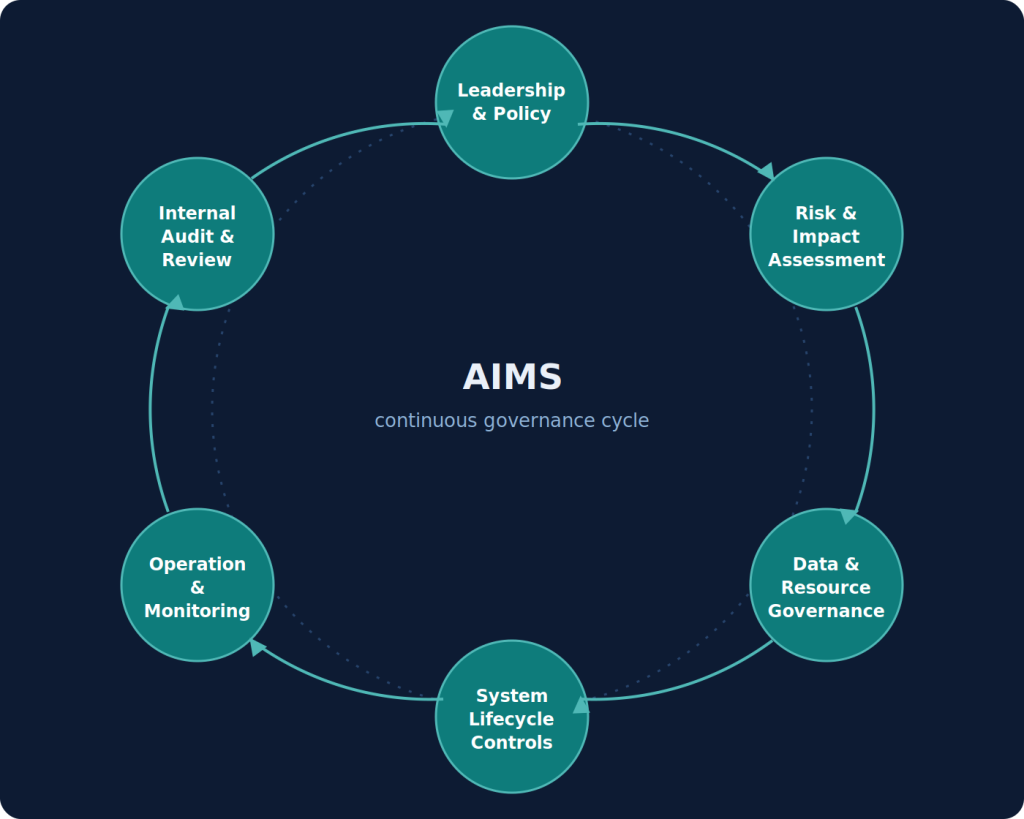
An AI Management System (AIMS) is not a set of ethics principles hung on a website. It’s a structured, documented, and auditable system of policies, roles, risk processes, and controls that governs how AI is designed, developed, deployed, and monitored across its lifecycle. The distinction matters: ethics guidelines describe intent, an AIMS proves execution — with evidence a third-party auditor can inspect.
ISO 42001 Explained applies broadly. It doesn’t only target companies building foundation models — it applies to any organization that develops, provides, or uses AI systems, including those that simply integrate a third-party model into a product.
| Organization Type | Typical Example | Why ISO 42001 Applies |
|---|---|---|
| AI developers | Companies building or fine-tuning ML/LLM models | Full lifecycle responsibility, from training data to deployment |
| AI providers | SaaS platforms embedding AI features into their product | Must govern how third-party or in-house models are exposed to users |
| AI deployers / users | Enterprises using AI tools operationally (HR, finance, support) | Accountable for outcomes even when the model is bought, not built |
| Regulated sectors | Fintech, healthtech, insurance, public sector vendors | Enterprise buyers and regulators increasingly ask for AI-specific governance evidence |
How ISO 42001 Explained Is Structured
ISO 42001 follows the same Annex SL high-level structure used by ISO 27001, ISO 9001, and most modern management-system standards. That’s a deliberate design choice — it means an organization already running an ISO 27001 ISMS can extend it into an AIMS rather than building a parallel system from scratch. Clauses 4 through 10 carry the auditable requirements; everything before Clause 4 is scope and definitions.
| Clause | Focus Area | What It Requires |
|---|---|---|
| 4 | Context of the Organization | Define the AIMS scope, interested parties, and how AI fits the organization's role (developer, provider, or user) |
| 5 | Leadership | Top management commits to an AI policy, assigns roles, and takes accountability for AIMS outcomes |
| 6 | Planning | AI risk assessment and AI system impact assessment (AIIA) — the standard's most distinctive addition |
| 7 | Support | Resources, competence, awareness, communication, and documented information |
| 8 | Operation | Operational planning and control across the AI system lifecycle, from design to retirement |
| 9 | Performance Evaluation | Monitoring, internal audit, and management review of the AIMS |
| 10 | Improvement | Corrective action and continual improvement of the management system |
✎ The AI Impact Assessment is the part most teams underestimate
Clause 6 requires more than a generic risk register. Organizations must run an AI system Impact Assessment that considers effects on individuals, groups, and society — bias, fairness, and unintended downstream consequences — not just security or availability risk. Teams that treat this as a copy-paste from their information security risk assessment tend to struggle at Stage 1 audit.
Annex A: The 38 Controls
Where Clauses 4–10 set out what the management system must do, Annex A translates that into a reference catalogue of controls an organization draws from. ISO/IEC 42001:2023 lists 38 controls organized into nine control objectives, numbered A.2 through A.10. As with ISO 27001, these controls aren’t a checklist to implement in full — they’re a menu, and every inclusion or exclusion has to be justified in a Statement of Applicability (SoA), driven by the risk and impact assessments from Clause 6.
| Objective | Theme | Covers |
|---|---|---|
| A.2 | AI Policies | Documented, board-level AI policy aligned to organizational strategy |
| A.3 | Internal Organization | Roles, responsibilities, and reporting lines for AI governance |
| A.4 | Resources for AI Systems | Data, tooling, computing resources, and human expertise allocated to AI |
| A.5 | Impact Assessment | Evaluating AI system effects on individuals and society before and during deployment |
| A.6 | AI System Life Cycle | Design, development, verification, validation, deployment, and monitoring controls |
| A.7 | Data for AI Systems | Data quality, provenance, labeling, and preparation practices |
| A.8 | Information for Interested Parties | Transparency and disclosure obligations to users, customers, and regulators |
| A.9 | Use of AI Systems | Responsible operational use, including human oversight mechanisms |
| A.10 | Third-Party & Customer Relationships | Supplier due diligence for AI components, models, and data sourced externally |
Why Organizations Pursue Certification
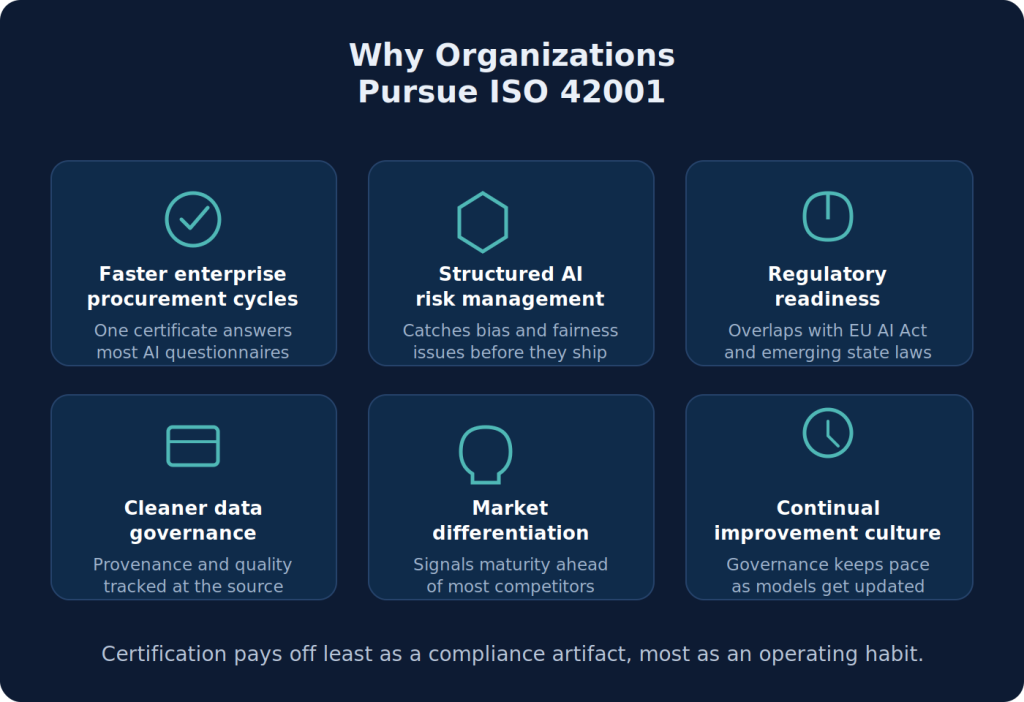
Certification is rarely chased for its own sake — it’s usually a response to a commercial or regulatory pressure point. In practice, the return on the effort shows up in a few consistent places.
ISO 42001 vs. ISO 27001
The two standards are complementary, not competing. ISO 27001 protects information; ISO 42001 governs the behavior and impact of AI systems built on top of that information. Most organizations that already hold ISO 27001 find roughly a third of their existing documentation — policy structure, internal audit process, management review cadence — reusable with light adaptation.
| Dimension | ISO 27001:2022 | ISO 42001:2023 |
|---|---|---|
| Primary focus | Confidentiality, integrity, availability of information | Responsible governance of AI systems and their impact |
| Structure | Clauses 4–10, Annex SL high-level structure | Clauses 4–10, same Annex SL high-level structure |
| Annex A controls | 93 controls across 4 themes | 38 controls across 9 objectives |
| Distinctive requirement | Information security risk assessment | AI system impact assessment (bias, fairness, societal effect) |
| Typical scope | Information assets and infrastructure | AI systems across their design-to-retirement lifecycle |
✎ One doesn’t replace the other
An AI product still needs ISO 27001 (or an equivalent) to prove the infrastructure around it is secure. ISO 42001 answers a different question: was the AI system itself built, trained, and deployed responsibly? Enterprise buyers in regulated sectors increasingly ask for both.
The Certification Process
Certification follows the same broad arc as any ISO management-system audit, with two AI-specific additions: the impact assessment work in Clause 6, and an Annex A control set that didn’t exist in any prior framework.
| Stage | What Happens | Typical Duration |
|---|---|---|
| 1. Gap analysis | Compare current AI governance against Clauses 4–10 and Annex A | 2–4 weeks |
| 2. Risk & impact assessment | Run AI risk assessment and AI system impact assessment per Clause 6 | 3–6 weeks |
| 3. Documentation & controls | Build policies, SoA, and implement applicable Annex A controls | 6–12 weeks |
| 4. Internal audit | Independent internal review of the AIMS before external audit | 1–2 weeks |
| 5. Stage 1 audit | Auditor reviews documentation and readiness | 1–2 days |
| 6. Stage 2 audit | Auditor tests evidence that controls operate in practice | 2–4 days |
| 7. Certification & surveillance | Certificate issued; annual surveillance audits; recertification every 3 years | 3-year cycle |
✎ Already ISO 27001 certified? You have a head start
Organizations with an existing ISMS typically move faster through Stages 1–3, since governance structure, document control, and internal audit processes can extend rather than restart. The heaviest new lift is almost always the AI risk and impact assessment — that work has no direct equivalent in ISO 27001.
Cost and Timeline Factors
There’s no fixed price for ISO 42001 certification — auditors quote based on scope, and the honest range depends on a handful of variables worth checking before budgeting:
- Number of AI systems in scope — one internal chatbot is a very different project from a portfolio of production ML models
- Existing management-system maturity — an ISO 27001-certified organization typically spends less than one starting from zero
- Data complexity — regulated data (health, financial, biometric) adds impact-assessment depth
- Use of a GRC platform — automated evidence collection tools can compress the documentation phase, at a recurring subscription cost
- Certification body fees — Stage 1/Stage 2 audit fees plus annual surveillance, separate from any consulting spend
Common Implementation Challenges
Defining AI system boundaries
Deciding what counts as “in scope” is harder than it sounds. A recommendation feature buried inside a larger product, a third-party model called through an API, an internal tool built by one team without security’s knowledge — all of these need a deliberate scoping decision before Clause 6 work can start.
Keeping impact assessments current
Models get retrained, fine-tuned, and swapped far more often than infrastructure changes. An impact assessment written once at launch goes stale fast unless it’s tied to a defined trigger — a model update, a new use case, a new data source — that forces a re-review.
Third-party and vendor AI risk
Most organizations don’t train their own foundation models — they build on top of someone else’s. Annex A’s A.10 objective requires due diligence on those relationships, which means contract language and vendor documentation become part of the audit evidence, not just internal policy.
Explainability documentation
Auditors expect evidence that a human can meaningfully explain how a system reached a decision, particularly for higher-risk use cases. For complex models, that often means investing in documentation and interpretability tooling earlier than product teams would otherwise prioritize it.
The Bottom Line
ISO 42001 is what happens when the AI industry admits that “we’re being careful” isn’t an audit trail. It doesn’t replace security certifications, and it doesn’t make an AI system infallible — what it does is force an organization to document how it identifies AI risk, who’s accountable for it, and how that accountability holds up when a model changes six months from now.
The organizations moving fastest on this aren’t necessarily the ones building the most advanced models. They’re the ones that can already answer, on short notice and with evidence, exactly which AI systems they run, what could go wrong with each one, and what they did about it.
Frequently Asked Questions
Is ISO 42001 legally required?
No. ISO 42001 is a voluntary, certifiable standard, not a law. That said, it’s increasingly used as evidence of compliance readiness for regulations like the EU AI Act, and enterprise customers in regulated sectors are starting to request it contractually.
How is ISO 42001 different from the NIST AI RMF?
The NIST AI Risk Management Framework is a voluntary, non-certifiable set of guidance published by a U.S. government agency. ISO 42001 is an international, certifiable management-system standard. Many organizations use NIST AI RMF as an internal risk-management reference and pursue ISO 42001 when they need a third-party-audited certificate to show customers.
Do small companies need ISO 42001?
The standard scales to organization size the same way ISO 27001 does — a small team can hold a proportionate, narrowly scoped AIMS. Whether it’s worth pursuing usually comes down to customer and regulatory pressure rather than headcount.
Can a company be certified for just one AI product?
Yes. Scope is defined by the organization during Clause 4 and can be limited to specific AI systems, business units, or product lines, rather than the entire company.
How long does ISO 42001 certification stay valid?
Three years, with annual surveillance audits in between to confirm the AIMS is still operating as documented, followed by a recertification audit at the end of the cycle.
Who audits against ISO 42001?
Accredited certification bodies that have been approved by a national accreditation body to audit against ISO/IEC 42001:2023 — the same type of organization that issues ISO 27001 certificates.