NIST AI RMF vs EU AI Act: What's the Difference
NIST AI RMF vs EU AI Act show up in the same conversation so often that it’s easy to assume they do the same job. They don’t. One is a voluntary framework that gives AI teams a common language for managing risk internally. The other is a binding regulation that a growing number of AI companies now have to comply with, whether or not they are headquartered in Europe. Treating the two as interchangeable — or assuming that following one automatically covers the other — is one of the more expensive misunderstandings an AI/ML team can carry into a board meeting or an enterprise security review.
This guide breaks down what each framework actually does, where the overlap genuinely helps, and how teams operating in both the US and EU markets typically put the two to work together.
Quick idea:
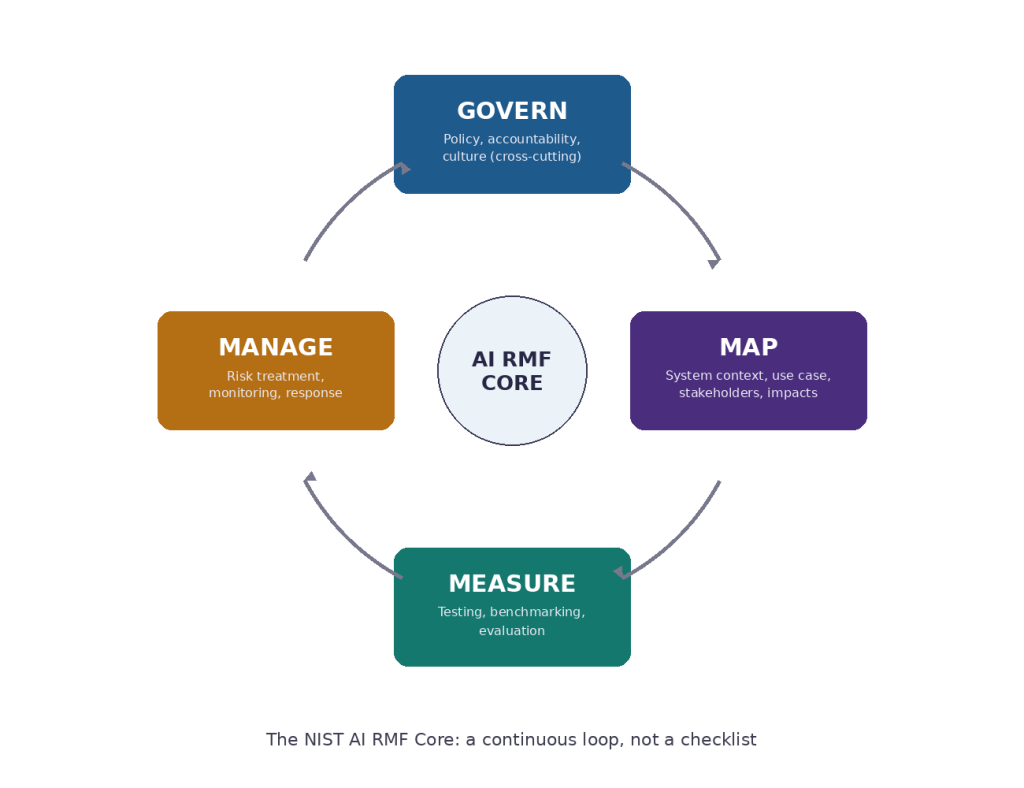
NIST AI RMF vs EU AI Act is voluntary US guidance built around four functions — Govern, Map, Measure, Manage — for managing AI risk inside an organization. It has no certification and carries no legal penalty. The EU AI Act is binding law that sorts AI systems into risk tiers and attaches concrete obligations, conformity requirements, and fines of up to 7% of global annual turnover to providers and deployers whose systems reach the EU market. Neither one substitutes for the other
- NIST AI RMF describes how to think about and manage AI risk; the EU AI Act sets out what you are legally required to do once a system is in scope.
- Being “aligned” with NIST AI RMF does not, by itself, satisfy any EU AI Act obligation — the practices overlap, but the legal requirement doesn’t disappear.
- Companies operating in both markets typically run NIST AI RMF as the internal risk process and treat the EU AI Act as the binding layer that determines what evidence they actually need to produce.
Important context:
B4Q Assurance works with AI/ML product companies sorting out exactly this — which obligations actually apply to a given system, and how to build documentation that satisfies EU AI Act requirements without duplicating effort across an internal NIST AI RMF program or an ISO/IEC 42001 AI management system.
What Each Framework Actually Is
NIST AI RMF 1.0, published by the U.S. National Institute of Standards and Technology in January 2023, is deliberately descriptive rather than prescriptive. It doesn’t dictate which controls to implement or how to build your product — it organizes AI risk management into four functions (Govern, Map, Measure, Manage) and leaves each organization to decide how to satisfy them based on its own risk appetite and use cases. There’s no certification body, no mandatory audit, and no penalty for skipping it. Its influence comes from adoption: it has become the default reference point regulators, enterprise buyers, and security questionnaires point to.
The EU AI Act (Regulation (EU) 2024/1689) is a different kind of document entirely. It’s binding law that entered into force on 1 August 2024 and is rolling out in phases through 2027. Rather than describing a process, it sorts AI systems into tiers — some practices are prohibited outright, some systems are classified “high-risk” and carry detailed obligations, general-purpose AI (GPAI) models get their own regime, and lower-risk systems face lighter transparency duties. It applies based on where an AI system’s output is used, not where the company is headquartered — so a US-only company can still fall inside its scope.
Side-by-Side Comparison
| Dimension | NIST AI RMF 1.0 | EU AI Act |
|---|---|---|
| Legal status | Voluntary guidance | Binding regulation |
| Published / effective | January 2023 | In force 1 Aug 2024; phased through 2027 |
| Geographic reach | Global, voluntary uptake | Applies wherever a system's output is used in the EU |
| Structure | Four functions: Govern, Map, Measure, Manage | Risk tiers: prohibited, high-risk, GPAI, limited, minimal |
| Certification | None | Conformity assessment for high-risk systems |
| Roles addressed | AI actors, generally | Provider, deployer, importer, distributor |
| Penalties | None | Up to 7% of global turnover or €35M for the most serious infringements |
| Best used for | Internal risk-management operating model | Legal compliance for EU-facing AI systems |
Where They Actually Overlap
Despite the difference in legal weight, the two frameworks aren’t unrelated — they were built to manage similar underlying concerns.
- Both push organizations toward identifying and treating AI risk systematically rather than reactively.
- Both call for human oversight of AI systems, though the EU AI Act turns this into a specific design obligation for high-risk systems rather than a general principle.
- Both expect testing for accuracy, robustness, and security before and after deployment.
- Both expect documentation that can be produced on demand — a regulator, auditor, or enterprise customer asking to see it shouldn’t trigger a scramble.
Where they diverge is enforcement. NIST AI RMF has no mechanism to compel any of this. The EU AI Act does, and that difference shapes how seriously each gets treated inside most organizations.
Mapping NIST's Four Functions to EU AI Act Obligations
For teams running both, the practical question isn’t “which one do we follow” — it’s whether the NIST AI RMF vs EU AI Act work already underway produces the evidence the EU AI Act asks for. Mostly, yes, with gaps.
| Role | Responsibility | Typical Title |
|---|---|---|
| AI risk owner | Accountable for the program; can pause or block a risky deployment | CISO, VP of AI, or Head of Risk |
| Compliance practitioner | Writes and maintains documentation, evidence, and the Current/Target Profiles | Compliance or GRC manager |
| Technical lead | Builds measurement infrastructure and runs the actual evaluations | ML/AI engineering lead |
| NIST Function | Roughly Maps To (EU AI Act) | What That Looks Like in Practice |
|---|---|---|
| Govern | Risk-management system and quality-management duties for providers | A named, accountable owner; a documented policy; an escalation path |
| Map | Technical documentation and system-scoping duties | Intended use, foreseeable misuse, and context written down per system |
| Measure | Accuracy, robustness, and cybersecurity testing duties | Test results tied to a specific system, not generic responsible-AI claims |
| Manage | Post-market monitoring and incident-reporting duties | A monitoring plan and an incident process, not ad hoc firefighting |
Worth knowing: A provider of a general-purpose AI (GPAI) model serving the EU carries obligations under the Act’s GPAI provisions that sit outside this mapping entirely. NIST published a companion Generative AI Profile in July 2024, but it’s a risk-management overlay — it doesn’t substitute for the EU’s GPAI requirements.
Which One Do You Actually Need?
- US-based, no EU exposure, no certification pressure from customers — NIST AI RMF as a voluntary internal operating model is usually enough to start.
- Placing an AI system on the EU market or using its output there — the EU AI Act applies regardless of where you’re based. Start by working out your role (provider, deployer, importer, distributor) and your system’s risk tier.
- Operating in both markets — the most common position for a growing AI company. Run NIST AI RMF as the day-to-day risk process and treat EU AI Act obligations as the binding layer for anything EU-facing.
- Selling a general-purpose AI model globally — EU AI Act GPAI obligations apply directly once the EU is one of your markets; NIST’s Generative AI Profile is a useful complement, not a substitute.
Common Misconceptions We See
- Assuming NIST AI RMF alignment automatically satisfies EU AI Act requirements — it doesn’t; the Act carries its own binding obligations regardless of internal risk-management maturity.
- Treating the EU AI Act as “an EU company problem” — it applies based on where a system’s output lands, not where the company is headquartered.
- Waiting for a specific customer or regulator to ask before determining risk tier — by the time that question arrives, there usually isn’t time to build the documentation from scratch.
- Assuming a certification exists for NIST AI RMF — it doesn’t. Organizations that want a certifiable AI governance standard generally look at ISO/IEC 42001 instead.
How B4Q Assurance Helps
B4Q Assurance works with AI/ML product companies to work out exactly which obligations apply — NIST AI RMF, EU AI Act, or both — and to build the risk documentation, testing evidence, and governance structure that holds up whether the audience is an internal risk committee, an EU market surveillance authority, or an enterprise customer’s security team.
Resources
- NIST AI RMF 1.0 (NIST AI 100-1) — the official framework document
- EU AI Act (Regulation (EU) 2024/1689) — full regulation text via EUR-Lex
- NIST Generative AI Profile (NIST AI 600-1) — supplementary guidance for generative AI systems
FAQs
Is the EU AI Act relevant if we're a US-only company?
Yes, if your AI system’s output is used in the EU — the Act applies based on market impact, not headquarters location.
Does following NIST AI RMF mean we're EU AI Act compliant?
No. The practices overlap, but the EU AI Act has its own binding, article-specific obligations that NIST AI RMF alone doesn’t produce evidence for.
Which one has penalties?
Only the EU AI Act. Fines run up to 7% of worldwide annual turnover or €35 million for the most serious violations, with lower tiers for other infringements.
Do we need both?
Most companies operating in both the US and EU markets end up running both — NIST AI RMF as the internal model, the EU AI Act as the compliance layer for EU-facing systems.
Is there a certification for either?
Not for NIST AI RMF. The EU AI Act requires conformity assessment for high-risk systems. ISO/IEC 42001 is the certifiable option many teams add alongside both.