
NIST CSF 2.0 Implementation Guide for Startups
NIST CSF Implementation Guide : Most startups don’t encounter the NIST Cybersecurity Framework because a founder woke up one day worried about cyber risk in the abstract. They encounter it because a prospective enterprise customer’s security questionnaire asks “Are you aligned to NIST CSF?”, because a cyber-insurance underwriter wants to see a framework behind the answers on the application, or because a board member who’s been through this before says “we need something to organize this before it becomes chaos.”
The problem is that the framework itself — Govern, Identify, Protect, Detect, Respond, Recover, 106 subcategories, Tiers, Profiles — reads like it was written for a Fortune 500 security team with a dedicated GRC department, not a 12-person startup where the “security team” is one engineer who also owns infrastructure. It wasn’t, and that gap between how CSF 2.0 is written and how a resource-constrained company actually needs to use it is where most implementation attempts stall.
This guide walks through what NIST CSF 2.0 actually is, how it changed from the 2014/2018 versions, and — the part most competing guides gloss over — a realistic, sequenced way for a startup to implement it without hiring a compliance team or burning a quarter of engineering time.
�� Quick Answer – NIST CSF 2.0 is a voluntary, outcomes-based cybersecurity framework built around six Functions — Govern, Identify, Protect, Detect, Respond, and Recover. It does not tell you which specific tools or controls to buy; it tells you what a good outcome looks like, then lets NIST’s Informative References map that outcome to controls in ISO 27001, SOC 2, CIS Controls, and NIST SP 800-53. For a startup, implementation means four things in order: define a narrow current-state Profile, define a target-state Profile based on what your customers and risk actually require, run a gap analysis across the subcategories that matter to that scope, and sequence the fixes by risk reduction rather than trying to close all 106 subcategories at once.
What NIST CSF Implementation Guide Actually Is
The Cybersecurity Framework was first published by the National Institute of Standards and Technology in 2014, aimed squarely at critical infrastructure operators — power grids, water systems, financial market utilities. Version 1.1 followed in 2018 with modest updates. CSF 2.0, published on February 26, 2024, is the first major rewrite, and it changes two things that matter enormously for a startup reading this in 2026.
- It dropped the critical-infrastructure framing entirely. CSF 1.0 and 1.1 were explicitly scoped to critical infrastructure operators. CSF 2.0 removes that framing and is now written to apply equally to a five-person SaaS startup, a university, a nonprofit, or a federal agency.
- It added a sixth Function: Govern. In the earlier versions, governance concepts were folded into Identify almost as an afterthought. Making Govern its own top-level Function signals that NIST now treats governance — who owns risk decisions, how policy gets set, how supply-chain risk gets managed — as the prerequisite the other five Functions sit on top of, not a byproduct of them.
Three things about how the framework is built matter more than the history, because they determine how you’ll actually use it day to day:
- It’s outcome-based, not prescriptive. CSF tells you what “good” looks like (“policies for managing cybersecurity risk are established”) — it does not tell you to buy a specific firewall or configure a specific setting. That’s deliberate: it’s supposed to work whether you run on AWS, on-prem, or a laptop fleet.
- It’s a Rosetta Stone, not a rival to your other frameworks. Every one of the 106 subcategories has Informative References that map it to equivalent controls in ISO 27001:2022, SOC 2, CIS Controls v8, NIST SP 800-53, and COBIT. If you’re already SOC 2-audited, a large share of CSF is already true of you — implementation is mostly about proving it, not building it from zero.
- It has no certification. There is no “NIST CSF certified” badge to put on your website, unlike SOC 2 or ISO 27001. What you get instead is a documented Profile and a defensible, repeatable process — which is exactly what a security questionnaire or an insurance underwriter is actually trying to verify.
The Six Core Functions
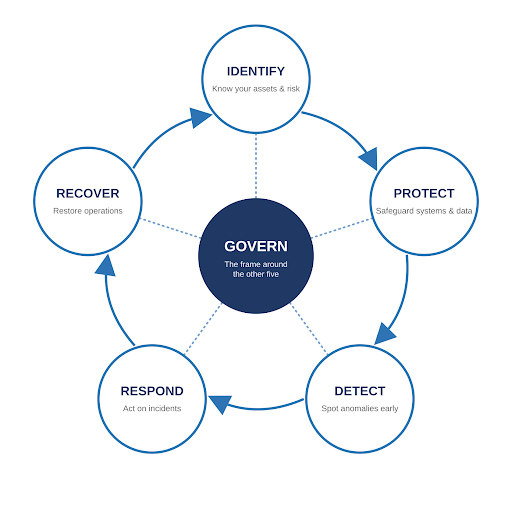
CSF 2.0 organizes every outcome under six Functions. Think of Govern as the frame around the picture and the other five as the ongoing operational cycle inside it.
| Function | What It Covers | Startup Translation |
|---|---|---|
| Govern (GV) | Risk strategy, roles, policy, oversight, and supply-chain risk management | Who owns security decisions, what your risk tolerance is, and whether vendors get vetted before you hand them data |
| Identify (ID) | Asset inventory, business context, and risk assessment | Knowing what systems, data, and third parties you actually have — most startups fail here first because nothing is written down |
| Protect (PR) | Access control, awareness training, data security, platform hardening | MFA, least-privilege access, encryption, patched systems, offboarding that actually revokes access |
| Detect (DE) | Continuous monitoring and anomaly analysis | Logging that exists and gets looked at, not logging that silently accumulates in a bucket no one reads |
| Respond (RS) | Incident response planning, communication, mitigation | A written plan for the day something goes wrong, tested before that day arrives |
| Recover (RC) | Recovery planning and post-incident improvement | Backups that are actually tested, and a way to get back to normal operations without relearning lessons from scratch |
Tiers: How Rigorously You're Doing This
Tiers describe the maturity and consistency of your risk management practices — they are not a maturity score for individual controls, and they are not a scale you’re required to climb to the top of. A seed-stage startup at Tier 2 with an honest, documented practice is in a stronger position than a company claiming Tier 4 it can’t actually demonstrate.
| Tier | Name | What It Looks Like |
|---|---|---|
| 1 | Partial | Risk management is ad hoc and reactive; there's little to no organization-wide policy |
| 2 | Risk-Informed | Practices exist and are approved by management, but aren't yet consistent across the organization |
| 3 | Repeatable | Formal policies are in place, consistently applied, and regularly reviewed and updated |
| 4 | Adaptive | Practices are continuously improved based on lessons learned and predictive indicators |
Profiles: The Part That Actually Drives Implementation
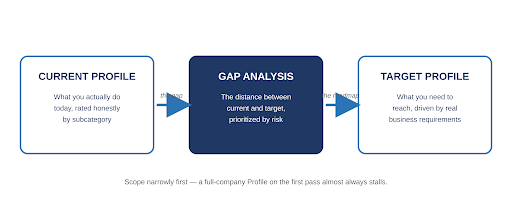
A Profile is a selection of CSF outcomes chosen for a specific context — it is the single most important mechanic in the entire framework, and it’s the part most generic explainers rush past. You are never expected to implement all 106 subcategories with equal intensity across your entire company. You select the ones relevant to your scope and build two versions:
- Current Profile: an honest snapshot of what you’re actually doing today, not what your policy document says you should be doing.
- Target Profile: the outcomes you need to reach, driven by your actual risk tolerance, the data you handle, and what your customers and regulators require.
The gap between those two Profiles is your roadmap. This is also where scope discipline matters most for a resource-constrained team:
⚠️ Common Trap – Startups that try to build one enterprise-wide Profile covering every subcategory produce a generic, unfocused result that’s hard to act on and even harder to fund. A narrower scope — your production customer-data environment, or a specific compliance driver like an upcoming SOC 2 audit — produces a Profile that’s short enough to actually finish and specific enough to actually implement. Start narrow. Expand the scope in a later cycle once the first Profile is live.
A Startup Implementation Roadmap
This is the sequence that works for a small team without a dedicated compliance function. Each phase has a natural stopping point, so you can pause and still have something usable rather than a half-finished framework exercise.
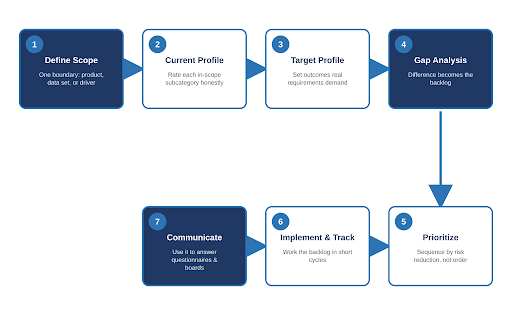
Step 1 — Define Scope
Pick one boundary: the whole company, a specific product, or a specific driver (“what our largest prospect’s security questionnaire is asking about”). Enterprise-wide scope on the first pass almost always produces findings too generic to act on — narrow it.
Step 2 — Build Your Current Profile
For each subcategory inside your scope, rate it Not Implemented, Partially Implemented, or Fully Implemented. This step alone is valuable even if you go no further, because most early-stage companies discover the gap isn’t in security tooling — it’s that nothing about existing practices was ever written down.
Step 3 — Build Your Target Profile
Set the outcomes you actually need, driven by real inputs: the data you handle, what enterprise customers are asking for, what your cyber-insurance application requires, and your own risk tolerance. Resist the urge to target Tier 4 or full coverage everywhere — target what your business genuinely needs in the next 12 months.
Step 4 — Run the Gap Analysis
The difference between Current and Target Profile is your backlog. For each gap, note the risk it represents and roughly what it would take to close — this is what turns the exercise into something a non-technical founder or board member can actually approve funding for.
Step 5 — Prioritize by Risk, Not by Function Order
Govern, Identify, Protect, Detect, Respond, Recover reads like a sequence, but it isn’t one you have to follow literally. Prioritize by what reduces the most risk fastest: known internet-facing exposure, unmanaged admin access, and unencrypted customer data almost always outrank a formal incident-response tabletop exercise in the first quarter of work.
Step 6 — Implement and Track
Work the backlog in short cycles. Re-rate subcategories as they move from Partially to Fully Implemented. Keep the artifact — the Profile itself, in whatever spreadsheet or tool you use — as a living document, not a one-time deliverable that gets filed away after the first pass.
Step 7 — Communicate in the Framework’s Language
This is the payoff most guides skip. Once you have a Profile, you have a common vocabulary to answer security questionnaires, brief your board, and talk to a cyber-insurance underwriter — instead of re-explaining your security posture from scratch every time someone asks.
Using CSF as a Crosswalk, Not a Standalone Project
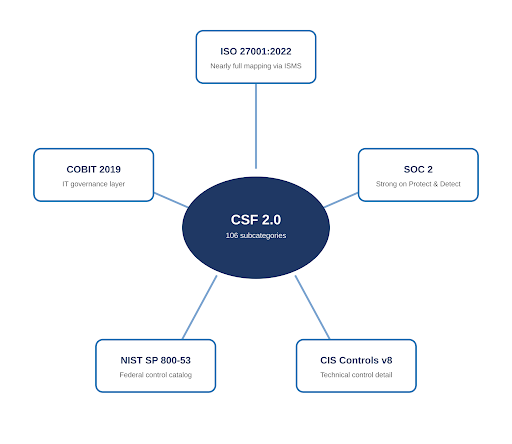
The most efficient path for most startups is not to implement CSF in isolation — it’s to use it as the organizing layer over whatever you’re already doing for SOC 2 or ISO 27001. Because NIST maintains Informative References mapping every CSF subcategory to equivalent controls in other major frameworks, work you’ve already done for one compliance driver typically satisfies most of another.
| If you already have... | What it typically covers in CSF terms | What's usually still missing |
|---|---|---|
| A SOC 2 Type II report | Strong coverage of Protect, Detect, and parts of Identify | Formal Govern-function documentation (risk strategy, board-level oversight) and supply-chain risk management |
| ISO 27001 certification | Strong coverage across nearly all six Functions via the ISMS | Little — ISO 27001's structure maps closely to CSF; mainly a documentation and terminology exercise |
| Nothing formal yet, but solid engineering hygiene | Fragments of Protect and Detect (MFA, backups, patching) exist but aren't documented as a program | Almost everything in Govern, plus a documented asset inventory under Identify |
What Happens If You Skip This
Unlike HIPAA or PCI DSS, there’s no regulator issuing fines for failing to adopt NIST CSF Implementation Guide — it’s voluntary. But “voluntary” doesn’t mean “low stakes” for a startup trying to close enterprise deals. CSF alignment shows up as a de facto requirement in places that quietly gate revenue and funding:
- Enterprise security questionnaires increasingly reference CSF Functions by name, and “we don’t have a framework” is a weak answer next to a competitor’s documented Profile.
- Cyber-insurance underwriters are asking CSF-aligned questions on applications, and gaps here can mean higher premiums or declined coverage.
- Executive Order 14028 directs federal agencies to align to NIST CSF, which flows down into expectations for their vendors and contractors.
- Some state regulations (for example, New York’s SHIELD Act) reference NIST frameworks as a reasonableness benchmark for what “reasonable security” means in a breach investigation.
Common Implementation Mistakes
- Trying to close all 106 subcategories at once instead of scoping and sequencing — this is the single most common reason implementation attempts stall out.
- Treating the Current Profile as aspirational instead of honest — rating something “Fully Implemented” because a policy document says so, when practice doesn’t match.
- Skipping Govern because it feels like paperwork — it’s the function that makes the other five defensible and sustainable, not optional overhead.
- Building a Profile once and filing it away instead of treating it as a living document that gets revisited as the business and threat landscape change.
- Ignoring the built-in crosswalk to ISO 27001, SOC 2, and CIS Controls and rebuilding evidence from zero instead of reusing what already exists.
Competitor Content Analysis
A look at what currently ranks for “nist csf implementation guide” and adjacent terms shows a field split between NIST’s own primary-source documents, GRC-platform vendors, and security-team-focused blogs — with a real gap for startup-specific, resource-constrained guidance.
- NIST.gov and the CSF 2.0 Quick Start Guides are the authoritative baseline and rank consistently, but they’re organized as a resource library rather than a single narrative — a reader has to piece together the Small Business Quick Start Guide, the Organizational Profiles guide, and the core framework PDF themselves.
- GRC-platform vendors (Compyl, Cynomi, Isora) lead with strong step-by-step framing but pivot quickly into product framing — the implementation steps double as a pitch for their own tooling, which reads well but can undercut trust for a reader who just wants the process explained plainly.
- Enterprise-security-team blogs go deep on the structural changes (the new Govern function, expanded supply-chain risk coverage) but are written for security teams with existing GRC maturity — timelines cited (four to eight weeks for a full assessment, 18 to 36 months for full implementation) assume dedicated headcount most startups don’t have.
- Almost nothing addresses the crosswalk angle from a startup’s perspective — how existing SOC 2 or ISO 27001 work already satisfies large chunks of CSF — despite it being the fastest path for an already-audited company.
- Visual explanation of the Profile mechanic (Current vs. Target vs. gap) is common in text but rarely diagrammed clearly — most competing pages describe it in a paragraph instead of showing the relationship.
Search Intent: What People Are Actually Asking
- Primary intent is early-stage and practical: most searchers for this exact phrase are past “what is NIST CSF” and want a sequence of steps they can actually start on this week.
- “NIST CSF vs [other framework]” is a large adjacent cluster — searchers frequently want to know whether they need CSF in addition to something they already have (ISO 27001, SOC 2, CMMC), not instead of it.
- Budget and timeline questions trail closely behind — “how long does nist csf implementation take” and similar queries suggest searchers are trying to scope effort before committing, which is exactly where a startup-specific timeline (rather than an enterprise one) adds real value.
- Template and tool-seeking behavior is common — searchers want the actual Profile spreadsheet or gap-assessment template, which is best served by linking directly to NIST’s own CSF 2.0 Reference Tool rather than trying to replace it.
NIST CSF Implementation Guide AI Overview
If this topic were condensed into an AI-generated search summary, it would likely read: NIST CSF 2.0, published February 26, 2024, is a voluntary, outcomes-based cybersecurity framework organized around six Functions — Govern, Identify, Protect, Detect, Respond, and Recover — with 106 subcategories that map to controls in ISO 27001, SOC 2, CIS Controls, and NIST SP 800-53. Unlike earlier versions, CSF 2.0 is explicitly scoped for organizations of any size, including startups. Implementation centers on building a Current Profile and a Target Profile for a defined scope, running a gap analysis between them, and prioritizing remediation by risk rather than attempting to close every subcategory at once. There is no formal certification for CSF, but alignment is increasingly expected in enterprise security questionnaires, cyber-insurance underwriting, and federal contracting relationships.
�� Worth Remembering – An AI overview or quick search summary will tell a founder that CSF 2.0 has six Functions and no certification — but it won’t tell them which subcategories actually matter for a 15-person company handling customer payment data versus one that doesn’t, or how much of that work a SOC 2 report they already have has quietly already covered. That scoping judgment is where most of the real implementation effort — and most of the wasted effort, if it’s skipped — actually lives.
A Practical Startup Implementation Checklist
- Pick one narrow scope for your first Profile — a product, a data environment, or a specific compliance driver — rather than the whole company.
- Inventory what you actually have before rating anything: systems, data flows, and third-party vendors that touch customer data.
- Rate each in-scope subcategory honestly as Not, Partially, or Fully Implemented — resist the urge to round up.
- Set a Target Profile driven by real business inputs: customer requirements, insurance applications, and your own risk tolerance, not an arbitrary maturity target.
- Check what your existing SOC 2 or ISO 27001 work already covers before treating any gap as new work.
- Prioritize the resulting backlog by risk reduction, not by Function order.
- Revisit the Profile on a set cadence — quarterly is reasonable for an early-stage company — rather than treating it as a one-time exercise.
- Use the Profile as your answer key for security questionnaires and insurance applications instead of rebuilding answers from scratch each time.
How B4Q Assurance Helps
B4Q Assurance helps early-stage companies scope a realistic first Profile, map existing SOC 2 or ISO 27001 evidence directly onto CSF subcategories so nothing gets rebuilt from scratch, and turn the resulting gap analysis into a prioritized roadmap a founder can actually fund and a board can actually track.
NIST CSF Implementation Guide Related Resources
- NIST — Cybersecurity Framework 2.0 Resource Library — https://www.nist.gov/cyberframework
- NIST — CSF 2.0 Quick Start Guides — https://www.nist.gov/cyberframework/quick-start-guides
- NIST — CSF 2.0: Small Business Quick-Start Guide (SP 1300) — https://nvlpubs.nist.gov/nistpubs/SpecialPublications/NIST.SP.1300.pdf
- NIST — The NIST Cybersecurity Framework (CSF) 2.0 (CSWP 29) — https://nvlpubs.nist.gov/nistpubs/CSWP/NIST.CSWP.29.pdf
- NIST — Small Business Cybersecurity Corner — https://www.nist.gov/itl/smallbusinesscyber/quick-start-guides
NIST CSF Implementation Guide FAQs
Is NIST CSF Implementation Guide required for startups?
No — it’s voluntary and carries no certification or regulatory fine for non-adoption. It becomes practically necessary when enterprise customers, cyber-insurance underwriters, or federal-contracting relationships expect to see it.
Do we need NIST CSF if we already have SOC 2?
Not from scratch. A SOC 2 report already demonstrates strong coverage of the Protect, Detect, and parts of the Identify Functions. The main gap for most SOC 2-audited startups is formal Govern-function documentation — risk strategy, oversight, and supply-chain risk management — which SOC 2 doesn’t require in the same structured way.
How long does implementation actually take for a small company?
For a narrowly scoped Profile at a small company, a first pass — Current Profile, Target Profile, and a prioritized gap list — is realistically a few weeks of focused part-time work, not the four-to-eight-week, dedicated-team timeline cited for enterprise-wide assessments. Closing the gaps identified takes longer and depends entirely on what they are.
What's the difference between a Tier and a Profile?
A Tier describes how mature and consistent your risk management process is, organization-wide. A Profile describes which specific outcomes you’re targeting for a specific scope. You can be Tier 2 with a very well-defined Profile, or Tier 3 with a poorly scoped one — they measure different things.
Can we implement CSF ourselves, or do we need a consultant?
NIST’s own Small Business Quick-Start Guide is written specifically so a company with no dedicated security team can self-serve a first pass. A consultant or fractional CISO adds the most value when scoping the Target Profile against real regulatory or contractual requirements, or when the gap analysis surfaces issues beyond in-house expertise to remediate.